How Can I Feel More Confident Driving? UK and US Guidance
To feel more confident driving, start by identifying what unsettles you, get practical support for any skills you are unsure about, and build experience at a pace that is safe for you. You do not have to feel fearless. The aim is to stay alert, make sound decisions and stop treating every journey as a test of your worth.
Perhaps you know the route, but your stomach tightens as you pick up the keys. You worry about holding someone up at a junction. A missed turn feels embarrassing long after you have arrived. Or you have spent so long avoiding a particular journey that it now feels bigger than it once did.
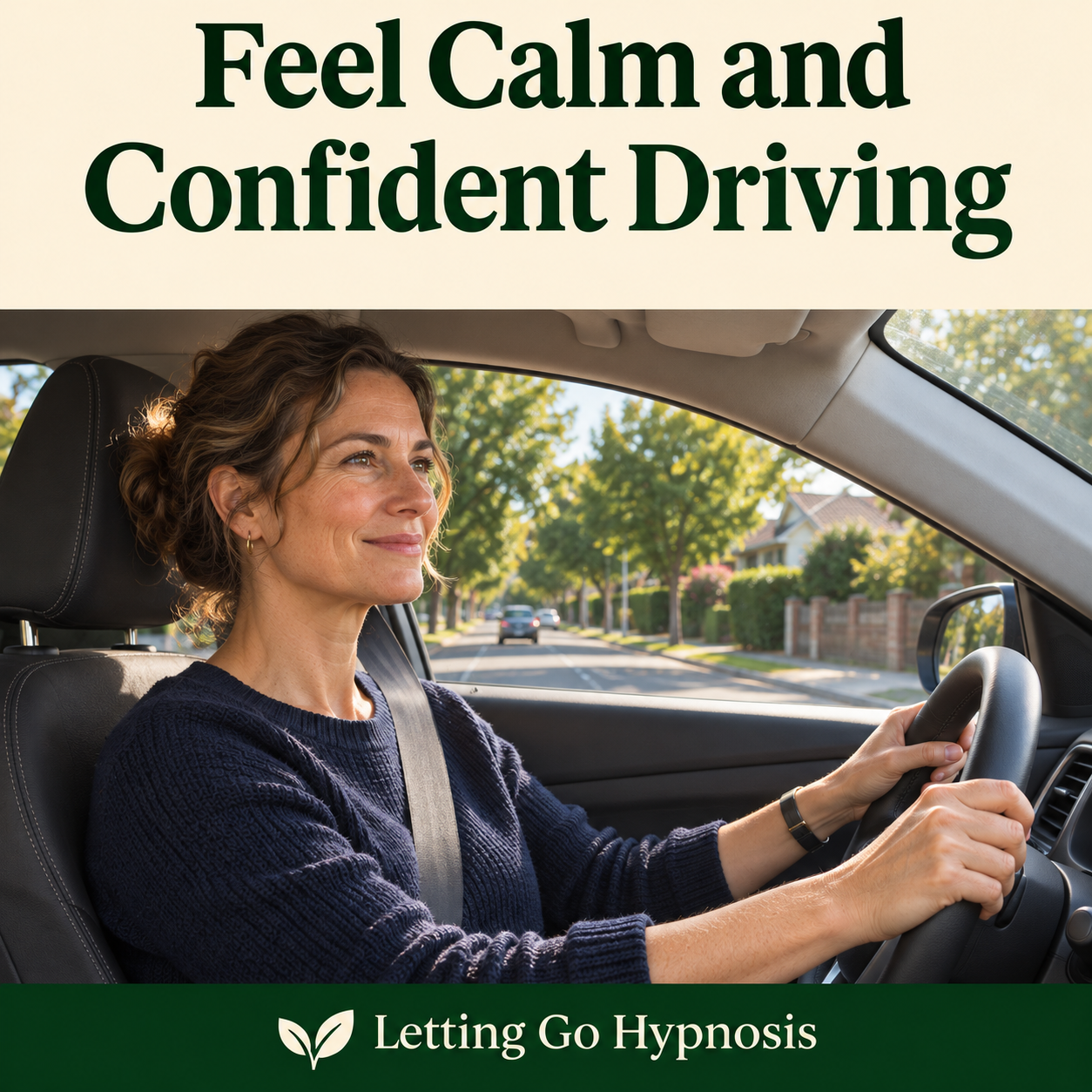
This guide accompanies Feel Calm and Confident Driving, our guided hypnosis recording with Theo. It includes practical ideas, official UK and US support links, and the full YouTube recording below.
Why do I feel nervous about driving when I already know how?
Knowing how to drive and feeling comfortable about driving are different things. You might be returning after a break, feeling shaken by a difficult experience, or worrying about unfamiliar roads and impatient drivers. Sometimes the pressure comes from your own running commentary: “I should find this easy by now.”
Try making the worry specific. “I hate driving” is difficult to work with. “I feel unsure about joining faster traffic” or “I keep imagining someone sounding their horn” gives you a clearer starting point. A practical skills concern and a fear of being judged may call for different kinds of support.
You do not need to diagnose yourself. If fear is persistent, overwhelming or interfering with daily life, a healthcare professional can help you understand what is happening.
What can I do to build driving confidence?
1. Separate a skill you need to practise from a feeling you dislike
Ask yourself: “What part of this journey do I need help with?” If it is a manoeuvre, road layout or gap in recent experience, discuss refresher lessons with an appropriately qualified driving instructor. Be specific about the situations you want to practise.
If you can carry out a task safely but spend hours dreading it or criticising yourself afterwards, support with the worry may also be useful. Feeling more positive cannot replace road knowledge, observation or vehicle control.
2. Choose a realistic next step
For someone already fit and legally entitled to drive, an instructor might help plan a short, familiar route before a more demanding journey. For someone with severe fear or panic, the first step may be a conversation with a clinician rather than another drive.
Graded work with feared situations is used in therapies such as CBT, but driving adds real safety responsibilities. Do not turn “face your fear” into an instruction to drive when you cannot do so safely. Agree a suitable approach with the right professional.
3. Take avoidable pressure out of the journey
Before setting off, check your route and parking arrangements, set navigation while stationary, and allow enough time. If a particular road worries you, ask your instructor to work through it with you rather than relying on last-minute reassurance.
Give yourself a simple priority: safe driving comes before keeping everyone else happy. Follow road rules and respond to actual conditions. Missing a turn does not justify a sudden or unsafe manoeuvre.
4. Stop marking every journey out of ten
When you are home and the car is parked, separate useful feedback from self-criticism. “I need help with that junction” points to a next step. “I am useless” does not.
You could write down one thing you handled safely and one question to discuss with your instructor. Then let the review end. Replaying the same moment all evening is different from learning something useful from it.
How can I let go of some of the pressure?
Try this only while safely resting at home, away from driving. Notice the thought that bothers you most: “What if I make a mistake?” or “People will think I am a bad driver.” Name the feeling without arguing with it: “There is worry here.”
You might ask, “Could I stop judging myself for feeling this, just for a moment?” Let your breathing stay comfortable. You do not have to force the feeling away or promise that the next journey will be perfect.
Then choose a useful action: arranging a refresher lesson, asking for support, or making a sensible plan. Our guide to the Letting Go Method explains this approach to feelings and self-judgement. These reflection exercises belong away from the wheel; real driving needs your attention on the road.
Where can I get help in the UK?
The NHS guide to anxiety, fear and panic explains support options. Speak to your GP if you are struggling to cope or self-help is not helping.
In England, adults can usually refer themselves to NHS talking therapies; the service also accepts 16- and 17-year-olds in some areas. A diagnosis is not required to self-refer. Elsewhere in the UK, ask your GP about the appropriate local route.
England, Scotland and Wales: DVLA guidance on anxiety and driving says you must tell DVLA if you have been diagnosed with anxiety and it affects your ability to drive safely. If driving is unaffected, you do not need to notify DVLA on that basis. Ask your doctor if you are unsure.
Northern Ireland: licensing is handled by DVA. See nidirect’s guidance on telling DVA about a medical condition. It explains notification requirements for conditions that may affect driving. Do not assume that Great Britain’s administrative process applies unchanged.
Where can I get help in the US?
Talk to a primary care provider or licensed mental-health professional if fear is restricting your life, causing panic or making driving feel unsafe. The National Institute of Mental Health’s psychotherapy guide explains approaches including CBT and exposure therapy. Professional treatment is tailored to the person; a general recording is not the same as that treatment.
For licence questions and local requirements, use USAGov’s state motor-vehicle services directory to find your own authority. Check its guidance and discuss any fitness-to-drive concerns with your clinician.
Medication deserves attention too. NHTSA’s guidance on prescription and over-the-counter medicines explains that some medicines can affect judgement, coordination and reaction time. Ask your prescriber or pharmacist about driving, particularly after a new medicine or dose change. Do not drive while impaired, and do not change prescribed treatment on your own.
What if I become overwhelmed while driving?
Keep your eyes open and focus on controlling the vehicle and the road around you. If you cannot continue safely, stop in a safe, legal place as soon as you can safely do so. Do not attempt an abrupt manoeuvre or use your phone while moving.
Once safely parked, arrange help or another way home if needed. Do not use hypnosis to try to carry on driving. Recurring episodes, faintness or symptoms you have not had assessed are reasons to seek medical advice rather than assume they are simply nerves.
Watch Feel Calm and Confident Driving
This full session lasts around 32 minutes. Theo guides you through a quiet garden beside a pond, space to loosen self-judgement, and an imagined familiar journey. You explore patient decisions, responding sensibly to a missed turn, and arriving without replaying every moment. The recording ends with a gradual return to alertness.
Listen only while safely resting, away from driving. Never listen while driving, including when stopped in traffic, or while operating machinery. Be fully awake and alert before driving afterwards.
Watch the recording on YouTube · Visit the Letting Go Hypnosis channel
The session is offered for relaxation and general wellbeing. It does not teach driving skills, replace individual care or guarantee that driving anxiety will disappear. Music: Mystic Dawn (Theta) by Christopher Lloyd Clarke, Enlightened Audio, used under licence.
Keep the ad-free recording
Prefer to listen without adverts? Get Feel Calm and Confident Driving as an MP3. Download it and keep it permanently, with no subscription. The full YouTube recording is free to listen to.
Explore more recordings at lettinggohypnosis.com.
Frequently asked questions
Can hypnosis help me feel more confident driving?
A recording offers time for relaxation and reflection away from the road. People respond differently, and it cannot promise a change in driving confidence or treat an anxiety disorder. Practical instruction and individual professional support may be more appropriate for your needs.
Should I listen in the car before a journey?
Plan the session for a separate period of safe rest at home. Give yourself enough time afterwards to become fully awake and alert. Never play it during a drive or use it to manage nerves in traffic.
Do I need to feel completely calm before I can drive?
The important question is whether you can drive safely, stay alert and make sound decisions. Feeling nervous does not answer that question by itself. If symptoms interfere with safe driving, do not drive and seek appropriate advice.
What if my worry is mainly about the driving test?
Read our separate UK and US guide to calming driving-test nerves. It covers preparation for being assessed and links to the matching test-focused recording.
Is this suitable for listeners in the United States?
The general relaxation and reflection can be used by US listeners while safely resting. Theo uses British English. The recording is not a lesson in road rules; your local laws, licence conditions and professional advice always take priority.
Official guidance links checked on 16 November 2026. This article provides general information and is not a personal assessment of your fitness to drive.