
How to Give a Wedding Toast When You’re Nervous
You have agreed to say a few words at a wedding. Now the thought of standing up seems much bigger than the speech itself. What if your voice shakes, the joke falls flat or you lose your place?
A useful starting point is to prepare a short, kind message with an obvious ending. You can practise delivering that message while leaving room for some nerves. This guide focuses on a brief wedding toast; check with the couple if they want a longer speech or particular formal thanks.
1. Ask what your part needs to cover
Before writing, check three things with the couple or organiser: when you will speak, roughly how long you have, and whether you are introducing another speaker. Ask about names and pronunciations too.
Put those answers at the top of your notes. Knowing that you are giving a two-minute toast after the main course is a more workable task than “give an amazing speech”. If other people are speaking, check who is covering thank-yous so that you do not accidentally repeat or omit them.
2. Choose one warm detail
Pick an ordinary moment that shows something you appreciate about the couple. Perhaps they made a new friend feel included, supported each other through a busy move or turned a rainy outing into a good afternoon.
Choose something you would happily tell with both people sitting beside you. If a story involves private information, ask first or leave it out. You do not need to compete with a professional comedian.
US-based Toastmasters International recommends a brief, personal and respectful toast, avoiding embarrassing stories. Its wedding guidance suggests staying within three minutes. Treat the organiser’s agreed timing as your guide.
3. Build a simple route to the final line
Use four prompts: your connection, one detail, what you appreciate, and your wish for them. Here is an original example to adapt rather than memorise:
“I’m Sam, and I’ve known Alex since we worked together. When Alex and Jamie moved house, they somehow made everyone helping feel like a guest. That welcome says a lot about them. I hope your home is always full of that same kindness. Please join me in raising a glass to Alex and Jamie.”
Your own version may be longer, but it does not need several stories. Write the final invitation in full so that you can reach it even if you decide to shorten the middle.
4. Make notes you can actually use
Print your opening and closing lines in large type. Between them, use a few clear prompts. Number the pages if you need more than one, and avoid a page turn halfway through a sentence.
Try holding the notes while standing or sitting as you intend to on the day. If the print is difficult to read at arm’s length, enlarge it now. A paper copy also avoids screen locks and notifications. Notes are part of your preparation; you do not need to hide them.
5. Rehearse the awkward moment as well as the smooth version
Read the toast aloud with a timer. Practise once for someone you trust and ask, “Was there anything difficult to follow?” Make one useful revision, then leave the wording alone for a while.
During another rehearsal, deliberately stop between two points. Look down, find the next prompt and continue. You can use a simple recovery line such as, “There’s one thing I especially want to say.” This gives you a prepared response if you lose your place.
If emotion interrupts, pause. Have some water available and allow yourself time. You can skip to your closing wish if you need to. Completing a heartfelt short toast is a reasonable outcome.
6. Check the practical details on the day
Ask where you will speak and how the microphone works. Arrange somewhere for your notes, check whether the organiser will introduce you, and make sure your glass is within reach for the ending.
Before your turn, let your breathing remain comfortable. The NHS breathing exercise linked below emphasises gentle breathing without forcing it. Try it during preparation if you find it useful; you do not have to complete an exercise or eliminate every nervous feeling before speaking.
Afterwards, ask whether you said what mattered. A small stumble does not need to become the main story you tell yourself about the occasion.
UK and US resources for further support
- NHS: breathing exercises for stress — a gentle practice to explore in your own time.
- Toastmasters International: tips for a wedding toast — practical guidance from the US-based speaking organisation.
- NHS: complementary therapies and hypnotherapy safety — suitability and precautions.
If fear of speaking causes persistent distress or leads you to avoid important parts of daily life, speak with your GP or a qualified mental health professional. This article provides general preparation ideas, not an assessment or treatment.
How Public Speaking Confidence may support your preparation
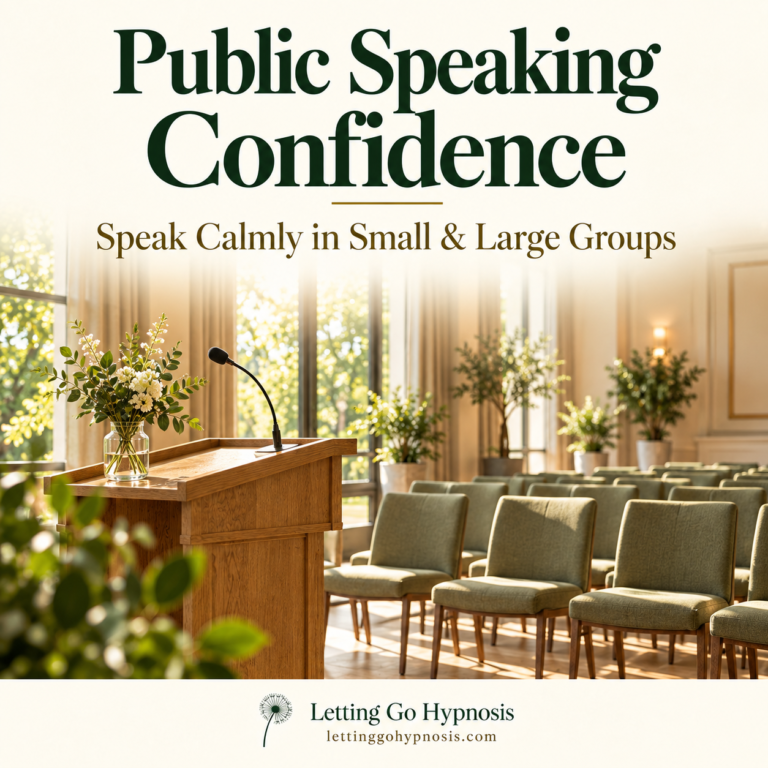
Public Speaking Confidence — Speak Calmly in Small & Large Groups is a 38-minute 24-second guided hypnosis session. It offers a separate period of relaxation and imagined rehearsal in a welcoming speaking space.
The Letting Go approach invites you to notice manageable feelings and explore loosening the pressure around them. Within the recording, you imagine speaking at your own pace, allowing pauses and gathering your thoughts. This may be a useful optional addition to practising your actual toast.
The recording is general wellbeing support. It does not guarantee confidence, a successful speech or relief from an anxiety disorder. The sources above support practical guidance; they do not establish this recording’s effectiveness or endorse Letting Go Hypnosis.
Listen to the complete recording
Explore the Social & Speaking Confidence Bundle
The Social & Speaking Confidence Bundle contains Public Speaking Confidence, Build Self-Confidence, and Social & Speaking Confidence. Choose a separate session for audience speaking, general self-belief or everyday conversations.
The bundle is £14.99 for three permanent MP3 downloads with no subscription. Build Self-Confidence is also free in the Android app; the other two website MP3s cost £13.90 together if those are all you need. Check existing purchases before buying. Prices checked on 4 November 2026.
Explore the app and related guides
Explore the Letting Go Hypnosis Android app, or continue with these related guides:
- Public speaking confidence for small and large groups
- How to stop replaying conversations in your head
Featured photograph: Al Elmes on Unsplash, used under its free commercial-use licence. Illustrative photograph; no endorsement is implied.