
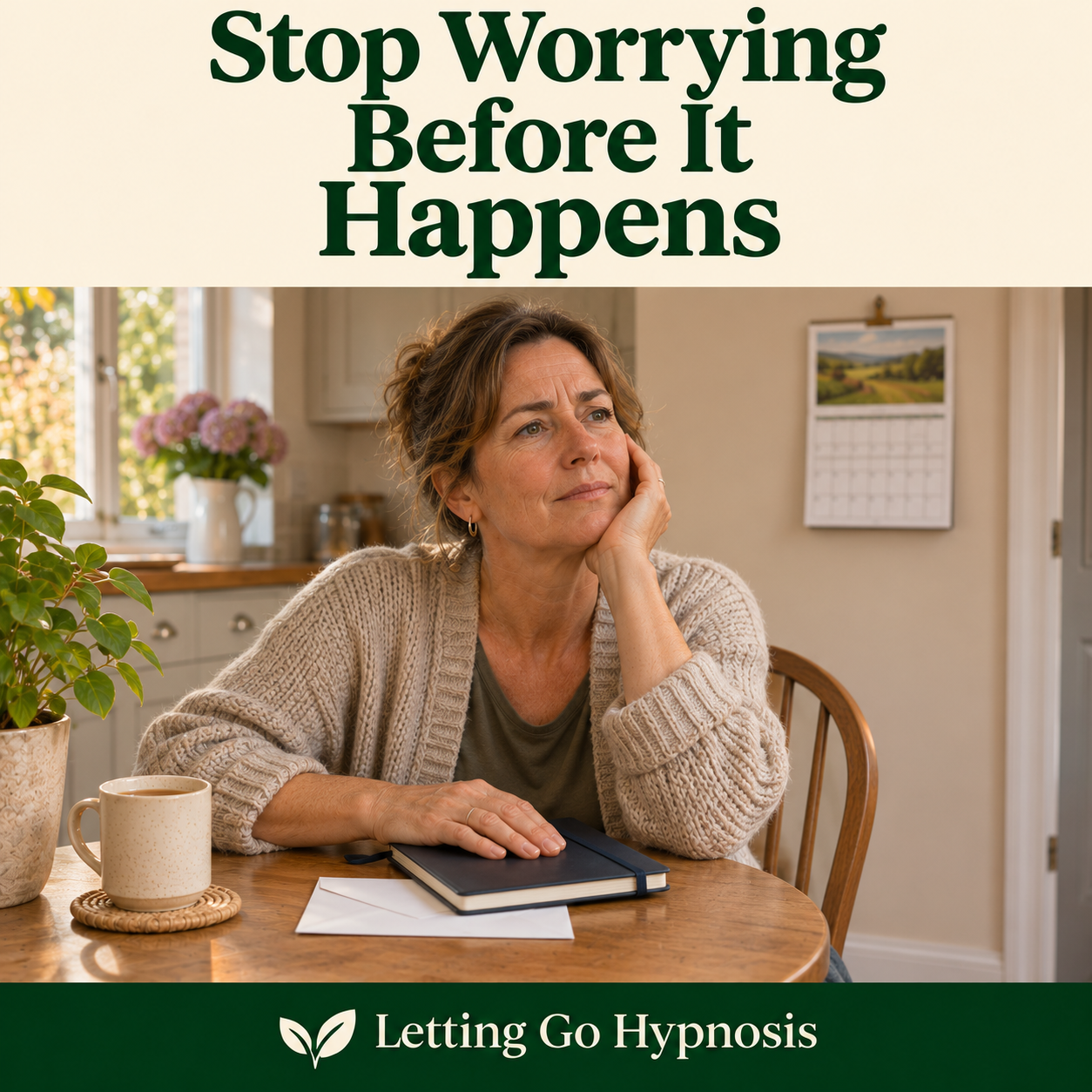
How Can I Stop Worrying About Tomorrow Before It Happens?
To ease anxiety about tomorrow, write down the specific worry, identify one useful action and give that action a time. When you have prepared as much as you reasonably can, practise returning to what is happening now. You can still feel uncertain and take the next step. If worry is affecting your sleep, work or everyday life, professional support is available.
You are making a cup of tea, but your mind is already in tomorrow’s meeting. You rehearse what someone might say, imagine your answer and start again. Or you send a message, put your phone down and pick it up a minute later. Nothing has happened yet, but the waiting is taking over the evening.
This guide accompanies Stop Worrying Before It Happens, our guided hypnosis recording, published on YouTube as Ease Your Anxiety About Tomorrow. Below, you will find practical ideas, the full recording, answers to common questions and official help for readers in the UK and US.
What is anticipatory anxiety?
Anticipatory anxiety means feeling anxious about something that might happen in the future. It can centre on a specific event, such as an appointment or conversation, or on a less definite fear that something will go wrong.
The phrase describes an experience; it does not, by itself, diagnose an anxiety disorder. The important questions are how much time worry is taking, how difficult it feels to step away from it and whether it is stopping you from living as you would like.
A thought such as “What if I cannot cope?” is a prediction. You can acknowledge the fear without treating the prediction as a settled fact.
How can I tell useful planning from repeated worrying?
Useful planning produces a decision, an action or a time to revisit a problem. Repeated worry often circles the same possibilities without giving you new information.
| Situation | A useful preparation | When thinking starts circling |
|---|---|---|
| An appointment tomorrow | Check the time, route and information you need to bring. | Rehearsing every possible outcome after the practical details are settled. |
| A difficult conversation | Write down the main point you want to communicate. | Trying to script both sides of a conversation that has not happened. |
| Waiting for a reply | Decide when a follow-up would be reasonable. | Checking repeatedly and guessing what the delay means. |
Some concerns need action, advice or protection. Letting go of repeated mental rehearsal does not mean ignoring a real problem or accepting unsafe circumstances.
What can I do tonight if I am anxious about tomorrow?
1. Put one worry into a clear sentence
Try “I am worried I will forget what I want to say in the meeting.” This gives you a specific starting point. A page of possible disasters can make it harder to see what needs attention.
2. Choose a small action within your control
For the meeting, that might mean writing three notes. For an appointment, it might mean putting the letter and travel details by your bag. Ask: “What would count as enough preparation for this evening?”
3. Give planning an ending
Record anything that needs doing tomorrow, including when you will do it. Close the notebook. If another useful detail occurs to you, add it briefly; you do not have to restart the whole preparation.
4. Make room for the feeling
Notice where tension is showing up: perhaps your jaw, shoulders or stomach. Let your breathing stay comfortable. Try saying, “I am noticing worry.” You can leave the thought unanswered for a moment while feeling the support of the chair or looking around the room.
5. Return to one ordinary activity
Make supper, listen to a song or speak with someone you enjoy. Your attention may wander back to tomorrow. Gently bring it to the next thing you can see, hear or do. The exercise is returning, rather than achieving perfect calm.
These are optional practices for everyday worry. If focusing inward makes you feel worse, stop and orient yourself to your surroundings.
Can setting aside worry time help?
The NHS suggests trying a brief daily period, around 10 to 15 minutes, to put worries on paper and consider solutions. Its “worry tree” approach separates problems you can act on from hypothetical concerns outside your control. A practical worry can become a specific plan; an unanswerable possibility can be acknowledged without solving it tonight.
If a worry returns outside that period, note it for later and redirect your attention. This takes practice. The NHS guide to tackling your worries explains the technique in more detail.
How does the Letting Go Method fit with future worry?
Our approach invites you to notice the feeling beneath the “what if” story, allow it some space and explore whether you are willing to let a little of the pressure soften. You are not required to force a feeling away or persuade yourself that every outcome will be good.
For example, after making a sensible plan, you might notice the remaining urge to keep rehearsing. Pause with that feeling and ask, “Could I let this rest for a moment?” If the answer is no, acknowledge that too. A gentle approach leaves room for your actual experience.
This is a reflective self-help practice. It does not establish that emotions are physically stored or that releasing a feeling treats an anxiety disorder. You can read more in our practical guide to the Letting Go Method.
Watch: Ease Your Anxiety About Tomorrow
Stop Worrying Before It Happens is a full 34 minute 11 second guided hypnosis session with Theo’s calm British narration and softly mixed Mystic Dawn (Theta) music. It moves through relaxation, gentle emotional awareness and everyday imagined practice: making a useful plan, meeting a conversation one step at a time and waiting for a reply without guessing its meaning.
Watch the full recording on YouTube if the embedded player is unavailable.
Listen safely: Never listen while driving, operating machinery or doing anything requiring your attention. Choose a safe, comfortable place and a mild everyday concern. You can move, open your eyes or stop at any point. If imagery feels uncomfortable, leave it and notice the room around you. The session ends with a gradual return to waking awareness; become fully awake before standing.
This is a general wellbeing recording, not individual therapy or a substitute for healthcare. Responses vary, and the music is included as a relaxing listening backdrop, without a promise of a particular brainwave state or treatment effect.
Own the ad-free recording
Download Stop Worrying Before It Happens and keep the MP3 permanently, with no subscription.
Prefer to browse first? Visit lettinggohypnosis.com/shop for the full collection.
When should I get help for persistent worry?
Consider seeking support when anxiety repeatedly disrupts your sleep, concentration, work, relationships or ability to do everyday things. You do not have to wait until you are in crisis or certain of a diagnosis.
US National Institute of Mental Health guidance explains that persistent anxiety that interferes with life deserves professional attention. Treatments for generalised anxiety disorder can include psychotherapy, medication or both, chosen with a healthcare professional. CBT is an established treatment option. Everyday self-care can support care, but does not replace it.
UK help and guidance for anxiety and worry
- NHS Every Mind Matters: tackling your worries — practical information about worry time and problem-solving.
- NHS: getting help with anxiety, fear or panic — guidance on symptoms and seeking support.
- Find NHS talking therapies in England — eligible adults can refer themselves without a diagnosis or GP referral. This particular service finder covers England. Elsewhere in the UK, ask your GP or local health service about access.
US help and guidance for anxiety and worry
- NIMH: Generalized Anxiety Disorder — What You Need to Know — information about symptoms, treatment and seeking help.
- NIMH: help for mental illnesses — routes to professional support.
- FindTreatment.gov — a US treatment locator linked from NIMH guidance.
A primary care clinician can help you discuss what is happening and find an appropriate next step.
Frequently asked questions about worrying before things happen
Why do I worry about things that have not happened?
You may be trying to prepare for uncertainty by imagining possible outcomes. Sometimes that produces a useful plan; sometimes it becomes repeated rehearsal. Notice whether the thinking is giving you a concrete next step or taking you round the same possibilities.
How can I stop worrying about tomorrow at bedtime?
Write down the concern and any action for tomorrow, then move into a quiet evening activity. If bedtime worry keeps returning, our guide to quieting your mind for sleep explores that situation separately. Seek advice if sleep problems persist.
Is worrying about the future the same as generalised anxiety disorder?
No. Occasional future worry does not establish a diagnosis. If worry is persistent, difficult to manage or affecting daily life, speak with a qualified healthcare professional rather than diagnosing yourself from a blog.
Can guided hypnosis cure anticipatory anxiety?
This recording does not promise a cure. You can try it as an optional relaxation and reflective practice and judge whether it feels useful. Persistent or disabling anxiety needs individual assessment and appropriate care.
Is this a sleep hypnosis recording?
No. Stop Worrying Before It Happens ends with a gradual return to waking awareness. Choose a dedicated sleep session if you want a recording designed for bedtime.
Do I need headphones or a subscription?
Headphones are optional if you can hear comfortably and safely. You can watch the full recording free on YouTube or buy the ad-free MP3 to keep, without a subscription.
More listening and practical reading
- Own Stop Worrying Before It Happens
- Watch Ease Your Anxiety About Tomorrow on YouTube
- How to ease anxiety and let go of worry
- How to stop replaying conversations in your head
- What is the Letting Go Method?
- Browse the hypnosis recording shop
- Letting Go Hypnosis on Google Play
- Subscribe to Letting Go Hypnosis on YouTube
Published 19 November 2026 by Letting Go Hypnosis, a consumer brand of Letting Go Labs Ltd. Official guidance checked on this date. This article provides general information for adults and is not a clinical assessment. Narration: Theo. Music: Mystic Dawn (Theta) by Christopher Lloyd Clarke, Enlightened Audio, used under licence.





One Comment
Comments are closed.