
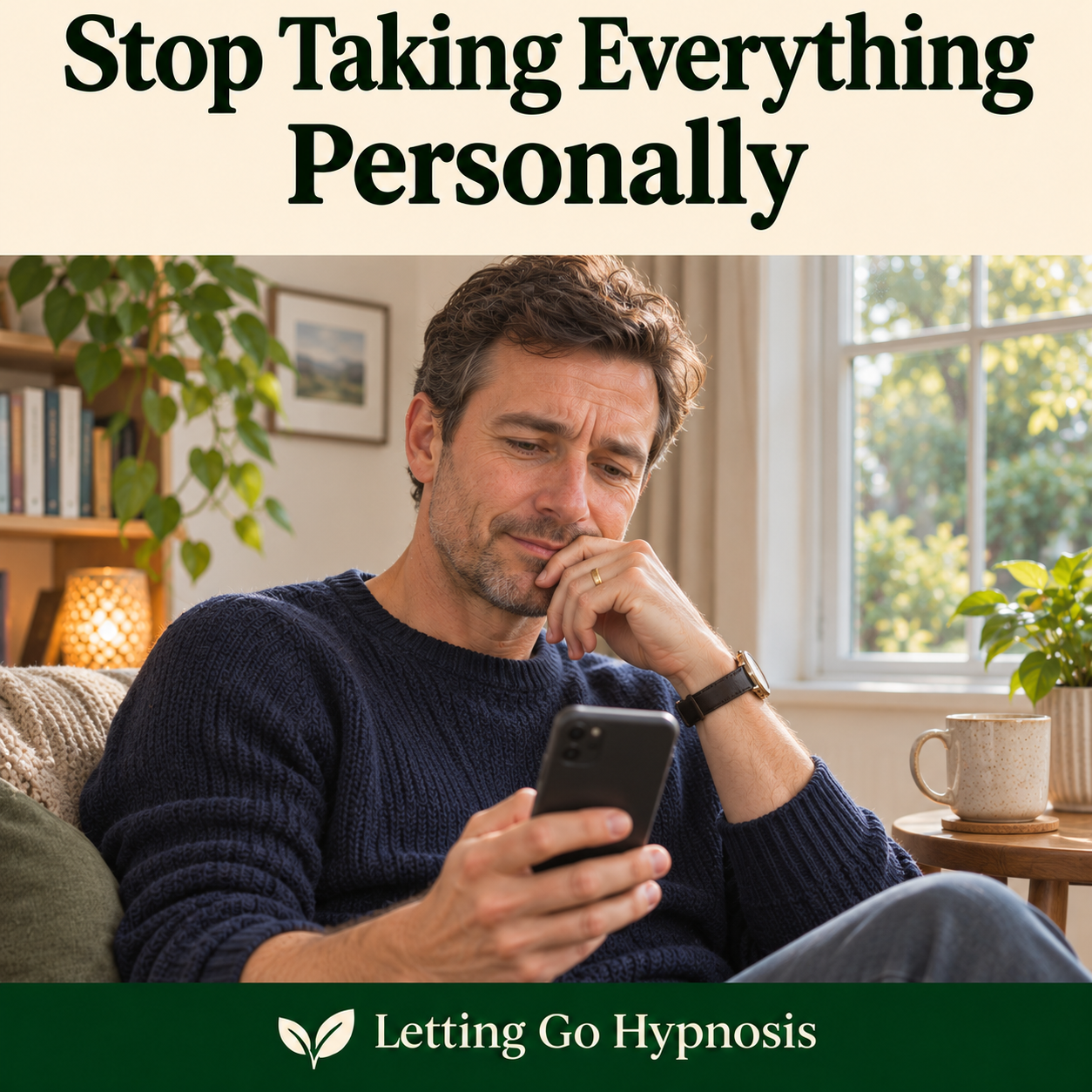
How Can I Stop Taking Everything Personally?
To stop taking everything personally, pause before reacting, separate what someone actually said from what you assumed, and ask for clarification when it would help. Give hurt feelings room to settle, consider other explanations and choose a response that respects your boundaries. The aim is to have more choice when something stings.
A friend replies, “Can’t today.” A colleague sounds impatient. Someone makes a passing remark over dinner. Hours later, you are still wondering what you did wrong.
This guide answers the questions people often ask about taking comments to heart. It accompanies Stop Taking Everything Personally, our 29 minute 53 second guided hypnosis recording with Theo and Mystic Dawn music. You can watch the recording below and find practical guidance and support links for the UK and US.
Why do I take everything personally?
Sometimes you give an uncertain situation a very personal meaning. “They sent a short reply” becomes “They are annoyed with me.” “They disagreed with my idea” becomes “They think I am useless.” The feeling is real, but the conclusion may still be untested.
Stress, tiredness, previous experiences and worries about approval can all be worth reflecting on. There is no single explanation that applies to everyone, and this habit alone does not establish a diagnosis. Start by noticing what happens in your own everyday situations.
How do I tell the difference between a fact and an assumption?
A fact describes what you observed. An assumption adds a meaning you have not confirmed. For example:
| What happened | The meaning you added | A more balanced response |
|---|---|---|
| A friend wrote, “Can’t today.” | “They don’t want to see me.” | “I know they cannot meet today. I do not yet know why.” |
| A colleague asked for changes. | “I am bad at my job.” | “There are changes to discuss. I can ask which part needs attention.” |
| Someone spoke sharply. | “I must have done something wrong.” | “Their tone hurt. I can ask what is happening and speak up about how I am being addressed.” |
You do not have to replace a painful guess with a cheerful guess. Leaving the meaning open can be enough.
What can I do in the moment when a comment hurts?
- Pause. Leave a brief gap before sending a defensive reply, apologising automatically or demanding reassurance. Take a comfortable breath if that helps.
- Name the feeling. Try “I feel hurt” or “I feel embarrassed.” Describe your experience without turning it into a verdict about your worth.
- Check what you know. Ask what was actually said, what you have added and whether there is another plausible explanation.
- Choose one useful action. Ask a question, address a specific issue, set a boundary or return to what you were doing.
The NHS Every Mind Matters guide recommends noticing unhelpful thoughts, examining the evidence and considering other ways to understand a situation. You can explore its guidance on reframing unhelpful thoughts. This does not require pretending that every interaction is positive.
How can I handle criticism without feeling worthless?
Look for the specific information you can use, and keep it separate from a judgement about your whole self. A request to change a report, a meal or a plan concerns that particular situation. You can consider it without agreeing with every word or accepting an insulting delivery.
Useful responses include “Which part would you like me to change?” and “Can you give me an example?” If you made a mistake, acknowledge the specific mistake and decide how to repair it. One correction does not have to become a catalogue of everything you dislike about yourself.
How do I stop replaying a conversation afterwards?
Try one brief reflection: What happened? What do I know? Is there a useful next step? If there is, write it down. If there is no further action to take, practise returning to something present, such as preparing dinner, reading or listening to a person who is with you.
When the same thought returns, you might say, “I have considered that. I do not have new information.” Then gently return your attention. Treat this as practice rather than another standard to fail. Repeatedly checking messages or asking the same question may give you more material to analyse without resolving the uncertainty.
Does taking things less personally mean tolerating disrespect?
No. You can question an assumption and still recognise behaviour that is hurtful or unacceptable. Letting a feeling soften does not remove your right to speak up, leave a conversation or seek support.
For example: “I want to hear what you are saying, but I would like us to speak respectfully.” Or: “I am going to pause this conversation. We can return to it later.” If there is an ongoing pattern of intimidation, control or abuse, prioritise safety and individual support. A relaxation recording is not a solution to another person’s harmful behaviour.
How does the Letting Go Method fit into this?
In this recording, the Letting Go Method means noticing the feeling, allowing it some space and exploring whether you are willing to let some of the tension soften. You can answer yes, no or “I am not sure.” A feeling does not have to disappear before you choose your next step.
For a mild everyday example, pause and ask: “What am I feeling?” “Can I allow this feeling to be here for a moment?” “Would I be willing to soften some of the effort around it?” Keep the exercise gentle and stop if it increases distress.
The practice gives you time to acknowledge what you feel and explore a gentler response at your own pace. There is no need to force an emotional release.
Can hypnosis help me stop taking things personally?
Guided hypnosis offers a structured opportunity to relax and rehearse a different response. Our session explores three familiar situations: a brief text reply, a sharp tone at home and a comment around the table. The suggestions invite you to pause, ask what someone means and participate without having to prove your worth.
This describes the recording’s intended use. It does not establish that this particular recording will produce a specific result. Experiences vary, and it is general wellbeing support rather than a replacement for assessment or treatment. The NHS and US organisations linked here do not endorse the recording.
Watch Stop Taking Everything Personally on YouTube
Listen to the complete 29 minute 53 second session, narrated by Theo, with softly mixed Mystic Dawn (Theta) music by Christopher Lloyd Clarke, Enlightened Audio, used under licence.
Watch the full recording directly on YouTube or explore more Letting Go Hypnosis recordings.
The music provides a gentle background for the narration and pauses. “Theta” in a track name is not evidence that listening will put your brain into a particular state or release emotions.
Listen safely: allow about 30 minutes in a quiet place where you can safely sit or lie down. Never listen while driving, operating machinery or doing anything requiring your full attention. Choose mild situations to explore. Open your eyes or stop whenever you wish, and become fully alert before returning to your day. The recording ends with a gradual return to awareness.
Own the ad-free recording for £6.95
Download Stop Taking Everything Personally and keep the MP3 for personal listening. One payment. No subscription. You can also explore more Letting Go Hypnosis recordings.
When should I get professional help?
If distress is persistent, affects sleep, work or relationships, or leads you to avoid everyday life, speak with a qualified professional. You do not have to wait until things become unbearable.
In the UK, a GP can discuss support. In England, eligible adults can self-refer to NHS Talking Therapies; arrangements differ elsewhere in the UK. The NHS anxiety guidance explains when to seek help.
In the US, the National Institute of Mental Health recommends discussing mental health concerns with a primary care provider, who can help arrange appropriate professional support. It also recommends everyday self-care, including sleep, relaxation and staying connected.
Where can I find UK support and helplines?
- Mind Infoline, England and Wales: 0300 123 3393, Monday to Friday, 9am to 6pm, except bank holidays. Mental health information and help finding support. See Mind’s helpline details.
- Samaritans, UK: 116 123, free, day or night, 365 days a year, when life feels difficult and you need someone to listen. Contact Samaritans.
- Finding ongoing care: contact your GP; readers in England can also use the NHS Talking Therapies link above.
Where can I find US support and helplines?
- NAMI HelpLine: call 1-800-950-6264 or text NAMI to 62640, Monday to Friday, 10am to 10pm Eastern Time, excluding federal holidays. Information, resources and peer support; it is not a crisis service. See NAMI HelpLine details.
- 988 Suicide & Crisis Lifeline: call or text 988 for free, confidential support, 24 hours a day. Official SAMHSA information about 988.
- Finding ongoing care: ask a primary care provider or use FindTreatment.gov to look for services.
If there is immediate danger or a life-threatening emergency, call 999 in the UK or 911 in the US.
Frequently asked questions
Can I stop taking things personally without becoming uncaring?
Yes. You can care about people and listen to feedback while leaving uncertain meanings open. A calmer response can include warmth, accountability and a clear boundary.
What if the person really is annoyed with me?
Ask about the specific issue when it is safe and useful. You can listen, take responsibility for your part and discuss a repair without accepting a sweeping judgement about your character.
How quickly will this change?
There is no fixed timetable. Notice small changes, such as pausing before replying or spending less time analysing one message. Seek individual help if the pattern remains distressing.
Is this recording suitable for listeners in the UK and US?
It is an English-language recording for adults, with British narration by Theo. The article includes separate UK and US support links so readers can find locally relevant care.
Do I need to buy the recording to try the practical steps?
No. You can use the suggestions in this article independently and watch the full recording on YouTube. The paid MP3 offers ad-free ownership for personal listening, with no subscription.
Written by Letting Go Hypnosis. Guidance and support details checked on 18 November 2026. Service availability can change; follow the linked organisations for current details. This article provides general information, not a diagnosis or individual treatment advice.





One Comment