How Can I Switch Off After Work and Let Go of Work Stress?
To switch off after work, finish with a clear plan for unfinished tasks, agree when you are available, and give yourself a simple transition into time at home. If work thoughts return, notice them, record any useful next step and gently return to what you are doing. Persistent work-related stress also needs attention to its causes, including workload, hours, support and working conditions.
You are home, but part of you is still at work. A conversation plays again while you make supper. You sit down with a book and remember tomorrow’s list. Your phone lights up, and your shoulders tighten before you have even read the message.
This guide accompanies Switch Off After Work, our 31 minute 34 second guided hypnosis recording. It explores practical ways to leave the working day behind, how the Letting Go Method fits into an evening routine, and where readers in the UK and US can find official guidance.
Why can’t I stop thinking about work when I get home?
Unfinished tasks, difficult interactions and uncertainty about tomorrow can keep pulling your attention back to work. Sometimes the problem is a habit of checking. Sometimes your workload or availability expectations leave very little space to recover.
Ask what your thoughts are asking you to do. Is there one task to write down? A conversation to arrange? An expectation about answering messages that needs clarifying? Identifying a specific concern gives you something more useful than repeatedly telling yourself to relax.
The US National Institute for Occupational Safety and Health (NIOSH) describes job stress as arising when work demands do not fit a worker’s resources, capabilities or needs. This makes work organisation part of the picture, alongside personal coping strategies.
What are the signs that work stress is spilling into home life?
You might notice irritability, trouble concentrating, difficulty sleeping or withdrawing from people you usually enjoy seeing. The NHS work-related stress guide also describes changes in confidence, motivation and working patterns.
A useful personal question is: “What has changed for me?” Perhaps you keep reopening your laptop, stop enjoying supper, or spend your days off anticipating your next shift. These experiences do not establish a diagnosis, but they can be reasons to seek support.
How can I leave work stress at work?
1. Give unfinished work a place to wait
Before finishing, write down what remains, its next practical step and when you can return to it. Keep the list short. “Ask which deadline takes priority tomorrow” is more useful than an evening of mentally rearranging an impossible workload.
For example: “The report needs its final figures. I will request them when I start at nine.” Once the next step is recorded, you can remind yourself that you have already made a plan.
2. Clarify what being off duty means
Discuss normal contact hours, urgent exceptions and any on-call duties. Where your arrangements allow, silence routine work notifications after your shift. Keep essential alerts available when you are responsible for responding.
If the expectation is unclear, try: “Which messages need a response outside my hours, and which can wait until my next shift?” Our guide to stopping evening work-email checking explores this specific habit.
3. Create a small transition into home life
Change your clothes, wash your hands, have a drink of water or take a short walk when practical. Choose something simple enough to repeat after a tiring shift. If you work from home, closing your work materials and moving to another seat can mark the end of the day.
This is a suggested routine to try, rather than a prescribed treatment. Your transition can happen in the morning after a night shift just as easily as in the evening.
4. Let your attention land on one ordinary activity
While preparing food, notice the sound of the pan and the warmth of the plate. While reading, follow one paragraph. When someone speaks, turn towards them and listen. You are giving your attention somewhere to go, rather than testing whether your mind has become completely empty.
5. Respond gently when work thoughts return
Ask whether there is new information or an action that genuinely needs taking now. If there is, deal with the necessary step. If the same concern is repeating, remind yourself when you will return to it and come back to your present activity.
A thought returning does not mean the evening is lost. You can return to supper, your conversation or your book more than once.
How does the Letting Go Method help me unwind?
Here, the Letting Go Method means noticing a feeling, allowing it some space and exploring whether some of the effort around it can soften. It is a gentle reflective practice, with no requirement to force a feeling away.
When safely resting, choose a mild, familiar example and ask:
- What am I feeling right now?
- Can I allow this feeling to be here for a moment?
- Would I be willing to soften a little of the tension around it?
You can answer yes, no or “I’m not sure.” Stop if the exercise increases distress. A feeling can be present while you choose a useful next action. Allowing tension to settle does not mean accepting bullying, unsafe conditions or an unmanageable workload.
People sometimes describe stress as “stored emotions.” In this article, that describes the experience of carrying lingering feelings and tension after work. It is not a claim that emotions are physically stored in tissues or that this recording removes them.
Can hypnosis help me switch off after work?
Guided hypnosis offers time to rest and mentally rehearse different responses. Switch Off After Work uses familiar home situations: settling into a chair, leaving a non-urgent message for later, enjoying supper and returning attention to a book. The aim is to practise being present at home while unfinished work waits for an appropriate time.
The session features calm British narration by Theo and softly mixed Mystic Dawn (Theta) music by Christopher Lloyd Clarke, Enlightened Audio, used under licence. The music provides a gentle backdrop through the pauses. It does not guarantee a particular brainwave state or a clinical result.
This recording is general wellbeing support. Individual experiences vary; it is not a treatment for burnout or a replacement for healthcare and workplace changes. The official organisations linked here provide independent guidance and do not endorse this product.
Watch Switch Off After Work on YouTube
Listen to the complete 31 minute 34 second recording free on YouTube.
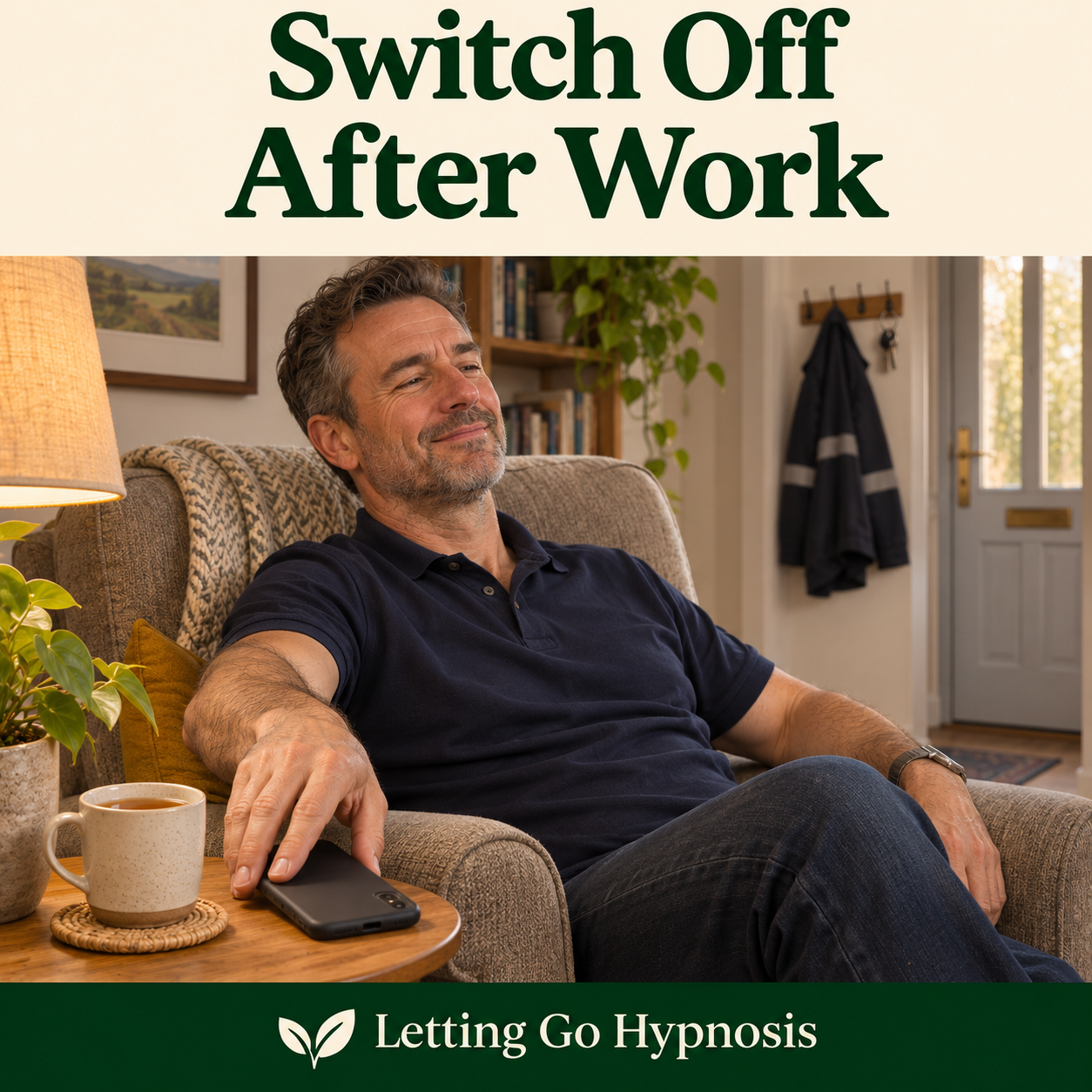
Tap the cover to watch on YouTube, or use the player below. If your cookie settings prevent the player loading, the cover link still opens the full recording.
Watch the full Switch Off After Work recording on YouTube.
Own your ad-free recording
Download Switch Off After Work for a permanent MP3 copy to keep and play offline. One payment, no subscription.
What UK guidance applies to work-related stress?
In Great Britain, employers must assess and act on risks from work-related stress. The HSE Management Standards cover six areas: demands, control, support, relationships, role and change. They offer an approach to managing these risks; personal relaxation does not replace employer action.
If you raise a concern, bring concrete examples such as repeated missed breaks, conflicting deadlines or unclear responsibilities. Ask for an agreed action and a review date. Where your manager is part of the problem, consider another manager, HR, a union representative or occupational health.
- HSE: work-related stress and how to manage it — employer responsibilities and risk assessment in Great Britain.
- Acas: managing work-related stress — causes, risk assessments, support and time off.
- NHS: work-related stress — practical coping advice and finding help.
- NHS: getting help with stress — when to speak to a GP and routes to further care.
Employment and healthcare arrangements differ across the UK. HSE and Acas guidance above concerns Great Britain; readers in Northern Ireland should use their local workplace and health services for advice about their circumstances.
What US guidance is available for workplace stress?
US guidance also recognises that working conditions matter. CDC recommends addressing organisational causes, including excessive demands, and supporting workers through changes in policies and practices. Employees can discuss concerns with a supervisor, HR, a union representative or an employee assistance programme where available.
- CDC/NIOSH: stress and work — how job demands and available resources affect stress.
- CDC: providing support for worker mental health — organisational prevention and practical coping.
- OSHA: workplace stress — resources for workers and employers.
These resources are guidance, not a statement that every recommendation is a specific legal entitlement. Employment protections depend on your location and circumstances. For persistent symptoms, contact your primary care clinician or a licensed mental health professional.
When should I get more help?
Seek professional advice if stress is affecting everyday life, your sleep is persistently disrupted, or attempts to cope are not helping. A GP in the UK or a primary care clinician in the US can help you consider appropriate support. Do not assume that new or worrying physical symptoms are caused by stress.
If tiredness or distress makes driving or safety-critical work unsafe, stop the activity safely and follow the relevant workplace safety procedure. A relaxation recording cannot make unsafe fatigue safe.
Frequently asked questions
Should I listen while driving home from work?
No. Never listen to hypnosis while driving, operating machinery or doing anything requiring attention. Use this recording only when safely off duty, sitting or lying down, with immediate responsibilities covered.
Is Switch Off After Work a sleep recording?
No. It is designed for unwinding and being present at home. It ends with a gradual return to ordinary awareness. Become fully alert before standing or resuming activities.
Can I use it after a night shift?
You can listen at a safe time after any shift, once home and off duty. If your main goal is sleeping during the day, read our guide to sleep after a night shift and choose a recording suited to bedtime.
Will one session cure burnout?
No. Neither a single session nor repeated listening promises that result. Persistent exhaustion needs attention to its causes and, when appropriate, professional assessment.
What if I am on call?
Keep required alerts and responsibilities in place. Choose another time if you need to stay ready to respond. The recording’s imagined message is one that can safely wait.
Do I need to buy the recording?
No. The full session is free on YouTube. Buying the MP3 gives you an ad-free copy to keep and use offline without a subscription.
More support from Letting Go Hypnosis
- Explore Stress & Relaxation recordings
- Explore Work & Career recordings
- How can I say no without feeling guilty?
- What is the Letting Go Method?
- Letting Go Hypnosis for Android
Official guidance checked on 19 November 2026. This article provides general wellbeing information, not individual medical or legal advice.