
Why Do I Start Things and Never Finish Them?
You start with good intentions. Then the job gets fiddly, the excitement wears off, or something else catches your eye. “I’ll finish it later,” you tell yourself. Weeks later, it’s still there.
If you keep leaving things half-done, look at the point where you stop. Are you unsure what comes next? Tired? Bored? Worried it won’t be good enough? A useful place to begin is one task, a clear finishing point and a small next step you can actually take.
The half-written email. The cupboard you emptied but never sorted. The course with three lessons left. You may recognise one of those more readily than another productivity plan.
What makes me stop halfway through?
Think of one thing you’ve left unfinished. What was happening the last time you worked on it?
- “I don’t know what to do next.” Perhaps you need an answer, a missing document or someone to show you how.
- “I’m bored with it now.” You liked getting started, but the remaining work feels repetitive.
- “It still isn’t good enough.” You keep changing the wording, adjusting the details or finding one more thing to improve.
- “I’ve got nothing left today.” Work, family and everything else have used up the time and energy you expected to have.
- “I don’t really want this anymore.” The project made sense when you began, but your priorities have changed.
These are questions to explore, not labels to put on yourself. Each answer points towards something different: asking for help, making a smaller plan, agreeing what’s good enough, resting or deciding whether to continue.
How do I finish something I keep putting off?
Choose one thing you still want to finish
Pick something modest: send the email, finish one application or put one shelf back in order. Leave the rest of the list alone for now.
Write down what finished means. For the email, that might be: “It answers the question, includes the attachment and has been sent.” That gives you somewhere to stop.
Make the next step easy to see
“Finish the application” can feel like a lot. “Find the date I started my last job” is a step you can recognise and complete. If you’re stuck, name the bit you need help with and ask one specific question.
The NHS Every Mind Matters guide to tackling your to-do list suggests trying an activity for five minutes, then checking how you feel. It also recommends choosing a suitable time and place for necessary tasks and planning a reward.
You could put your phone out of reach, open the document and work on the next unanswered question for five minutes. When the timer ends, decide whether to continue or choose a realistic time to return.
Notice what you’re avoiding
Just before you close the document or reach for your phone, pause. What’s there? Frustration? Uncertainty? The thought that you should have finished days ago?
Try naming it plainly: “I’m worried this sounds silly,” or “I don’t want to deal with this awkward bit.” You don’t have to settle every feeling before deciding what to do next. Sometimes that next step is a short break or asking for help.
Let finished be finished
For an everyday task, check it against the purpose you chose. Does the email say what it needs to say? Is the shelf usable? Has the form been checked and submitted?
Give important work the checks it needs. But if you’re rewriting a perfectly clear message for the sixth time, ask whether another edit will make it more useful—or simply delay sending it.
Give yourself a moment to enjoy it
Close the notebook. Put the tools away. Notice the empty space where the unfinished job used to sit. You’re allowed to feel pleased before reaching for the next thing.
In the US, the National Institute of Mental Health’s self-care guidance recommends deciding what needs doing now and what can wait, avoiding taking on too much and recognising what you have accomplished.
What if I’m too tired to finish anything?
Then the plan needs to take your actual day into account. After a long shift or a demanding day at home, a smaller task—or rest—may be more realistic than another evening of catching up.
The NHS guide encourages balancing necessary jobs with enjoyable activities. NIMH also includes sleep, regular meals and relaxation in its advice on looking after yourself. Leaving room for those things belongs in the plan.
Do I have to finish everything I’ve started?
No. Some commitments need completing, handing over or a conversation about what happens next. Other projects can be put away because you no longer want them.
There’s a difference between leaving something hanging and making a clear decision. You might tell someone your plans have changed, cancel a course you won’t use or give away supplies for a hobby you no longer enjoy.
Where does self-hypnosis fit in?
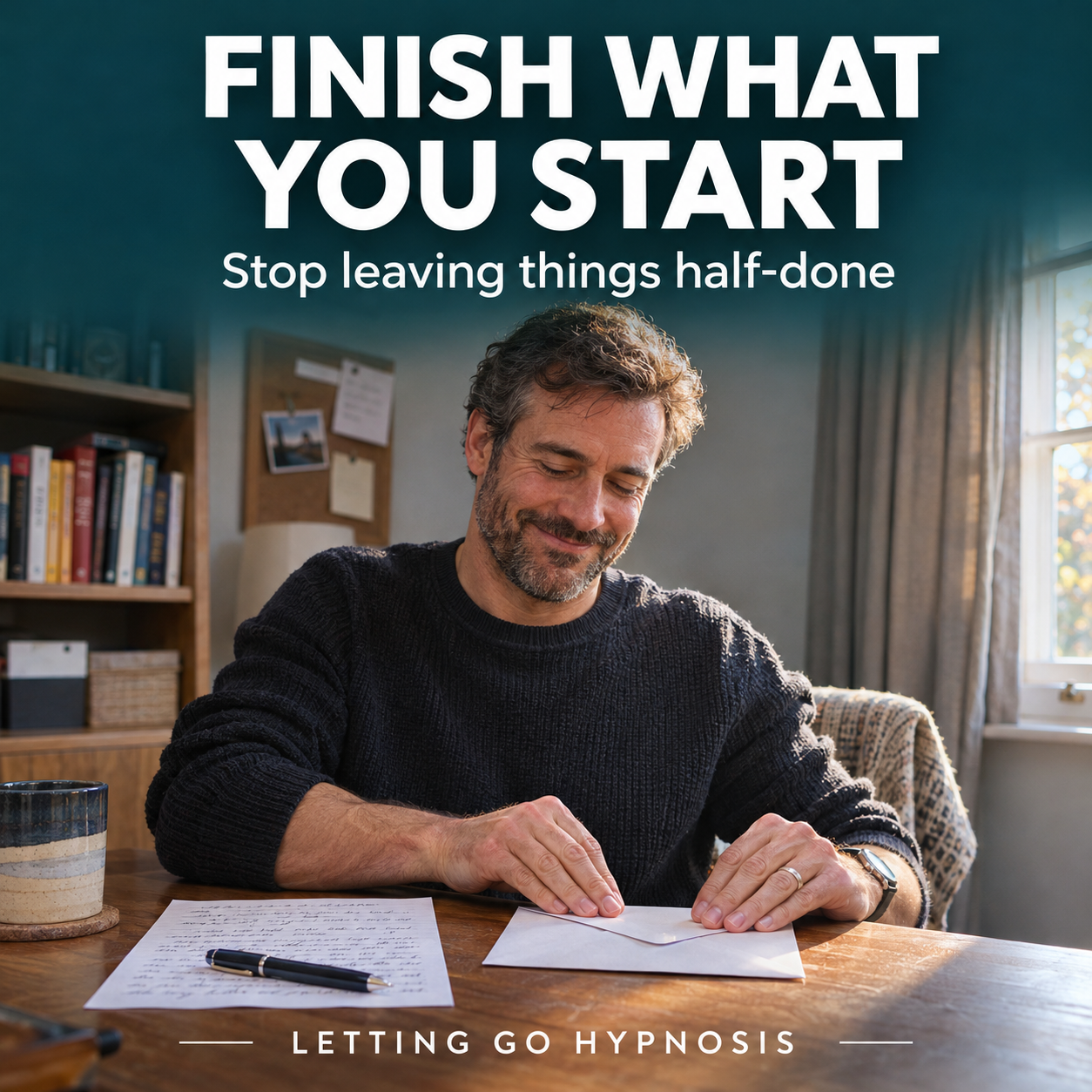
Finish What You Start is a 32-minute guided recording with Theo and Mystic Dawn music. You imagine returning to an unfinished letter, working through the awkward parts and finally sealing the envelope.
The session explores carrying on when the first burst of interest fades, easing the urge to keep polishing and enjoying the relief of completing something that matters to you.
It offers a way to relax and rehearse those moments. It cannot finish the task for you, and no particular result is guaranteed. The NHS and NIMH links here provide general guidance; they are not endorsements or evidence for this recording.
When is it worth getting some help?
If this is affecting your work, home life or wellbeing, talk it through with a health professional. You don’t need to work out the cause on your own.
UK: A GP can help you discuss what’s happening and what support is available. The NHS also explains talking therapies and how to access them.
US: NIMH advises seeking professional help for severe or distressing symptoms lasting two weeks or more, including difficulty concentrating or completing usual activities. Its guidance explains how a primary care provider can help. Seek advice sooner if you’re concerned.
Listen to Finish What You Start
Listen only while resting somewhere safe. Never play this recording while driving, operating machinery or doing anything that needs your full attention. You can stop at any time. It ends with a gradual return to wakefulness and is not a sleep recording or a substitute for medical or psychological care.
Useful links
- Finish What You Start — full recording on YouTube
- Finish What You Start — download the MP3
- Subscribe to Letting Go Hypnosis on YouTube
- Get the Letting Go Hypnosis Android app, with three free recordings
- More ideas for starting, focusing and keeping going
- UK guidance: NHS — tackling your to-do list
- US guidance: NIMH — caring for your mental health
Choose one thing you’d feel relieved to finish. What’s the next small part of it you can do?