How to Build Exam Confidence and Stay Calm Under Pressure
You sit down to revise, open the notes and suddenly everything seems important at once. A difficult topic becomes a prediction about the whole exam. Someone else says they have finished revising, and the work you have done starts to feel smaller.
Exam confidence can begin with a more workable aim: preparing as well as you can and knowing how to respond when nerves appear. You do not need to feel completely calm before taking the next useful step.
Whether you are at university, returning to education or studying for a professional qualification alongside work, this guide offers practical ways to approach revision, exam day and the period afterwards.
Make revision specific enough to start
“Revise everything” gives you a large task with no clear starting point. Try choosing a small, visible action: answer two practice questions, explain one concept without looking at your notes, or identify what you do not understand about a particular topic.
For example, an evening plan might be: “After dinner, I will spend twenty minutes on this question, check my answer and note one thing to revisit.” Adjust the time to your circumstances. The purpose is to make beginning possible, rather than create another rule to fail.
The NHS guide to preparing for exams recommends a realistic revision timetable, manageable chunks, breaks and asking for help. Leave room in your plan for topics that take longer than expected.
Prepare for the format as well as the subject
Knowing the material and knowing what you will be asked to do with it are different parts of preparation. Check the official exam guidance: question types, timing, permitted equipment and how answers are submitted.
Where practice materials are available, use them to spot a specific difficulty. Perhaps you understand the topic but spend too long planning an answer. Perhaps you miss an instruction when reading quickly. Each observation gives you something concrete to practise.
If you are studying around shifts or family responsibilities, plan around the time you actually have. A shorter session with one clear purpose may be more realistic than repeatedly scheduling an uninterrupted evening that never arrives.
Respond to pressure without adding an argument
Thoughts such as “I must remember everything immediately” or “One mistake will ruin this” can turn a demanding task into a running judgement about you.
Try a response that leaves room for uncertainty: “This matters to me, and I can work on the question in front of me.” You are not required to convince yourself that the exam will be easy.
A practical way to explore letting go is to notice the pressure, name what you are demanding of yourself and ask whether that demand can loosen slightly. Then return to an action you can take. This is an optional reflection, not a test of how well you can control your feelings.
Protect the parts of your day that support you
Build meals, rest and time away from revision into your plan. The NHS advice includes physical activity and making space to unwind. Sleep deserves a place in preparation, rather than whatever time remains after studying.
Give yourself a clear stopping point when possible. Before closing your notes, write down where you will begin next time. You can also ask friends to avoid late-night comparisons about how many hours everyone has studied.
Comparison rarely tells the whole story. Someone may have covered a chapter quickly without understanding it; another person may need longer and remember it well. Keep your attention on what your own practice is showing you.
Make exam morning less complicated
Prepare the practical details beforehand: the location or online sign-in instructions, start time, identification, permitted materials and travel arrangements. For an online exam, check the official technical requirements early enough to ask for help.
Choose a familiar routine where possible. Leave a reasonable margin for travel or setup, and decide whether last-minute group discussions help you or leave you more unsettled.
The test-anxiety resources from The Jed Foundation and College Board focus on preparation, perspective, keeping the mind and body calm, and directing attention towards the test itself.
What to do if your mind goes blank
A difficult moment does not tell you how the entire paper will go. The following is a simple response to practise beforehand and adapt to the exam rules:
- Pause briefly. Ease your grip on the pen or keyboard and allow a comfortable breath without forcing it.
- Read the instruction again. Identify what the question is asking, rather than trying to solve every part at once.
- Look for a starting point. A definition, short outline or relevant fact may give you something to work from.
- Use your time plan. If the format permits, move on and return later instead of spending all your time on one answer.
- Ask for help if you feel unwell. Follow the procedure for contacting an invigilator or online proctor.
These steps are an example, not a promise that recall will return immediately. You can make a sensible next choice while still feeling nervous.
Let the exam have an ending
After submitting, you may feel pulled into comparing every answer or replaying one uncertain response. Decide what would be useful before joining that conversation.
If another exam is coming, make a brief note of anything practical to adjust, then give yourself a break before returning to preparation. An extended discussion about an answer you can no longer change may leave less energy for what comes next.
A disappointing result can have real consequences, and you do not have to dismiss those feelings. When results arrive, ask your tutor or exam provider about feedback and the options available. A result is information about that assessment; it does not describe your whole ability or future.
Where to find support in the UK and US
If anxiety is repeatedly disrupting sleep, making it difficult to study or preventing you from attending exams, speak to someone before the next assessment. Your tutor, student support service or healthcare professional can help you consider appropriate support.
Ask your institution or exam provider early about adjustments or accommodations if you may need them. Eligibility, evidence requirements and deadlines vary; do not assume arrangements can be made on the day.
- UK: Start with the NHS exam-preparation guide and your college or university wellbeing service. Your GP can advise when anxiety is affecting daily life.
- US: Explore The Jed Foundation’s academic-stress resources and its test-anxiety toolkit with College Board. Your campus counselling, accessibility or academic support service can discuss your circumstances.
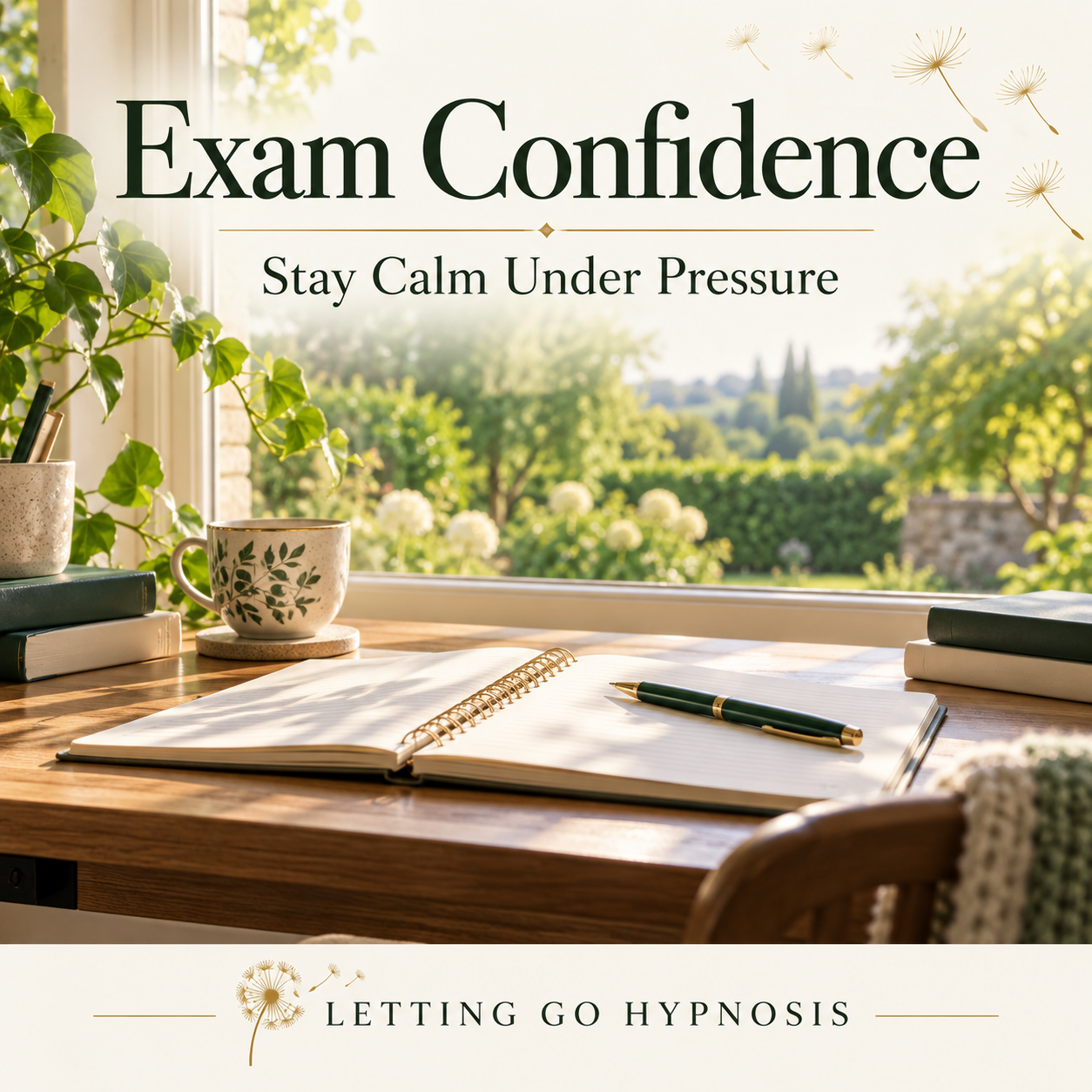
A quiet space to practise: Exam Confidence — Stay Calm Under Pressure
Alongside practical preparation, you may appreciate time to settle and rehearse approaching an exam with less pressure. Exam Confidence — Stay Calm Under Pressure is a complete 39-minute, 56-second guided hypnosis recording from Letting Go Hypnosis.
Theo’s narration guides you through settling, relaxation, deepening and the Letting Go process, followed by an imagined exam day and a gradual return to alertness. The session explores meeting nerves, responding to difficult questions, returning after distractions and easing the demand to perform perfectly.
The recording includes breathing pauses and softly mixed Mystic Dawn (Theta), by Christopher Lloyd Clarke, licensed through Enlightened Audio. Theo is an AI voice produced using ElevenLabs.
This is optional supportive listening for relaxation and emotional preparation. It does not teach the exam material, guarantee results or replace medical or mental health care. Individual experiences vary.
- Download the MP3 for £6.95 — a one-time payment with permanent access and no subscription.
- Listen to the full recording on YouTube.
- Explore the Study & Learning recordings.
- Get the Letting Go Hypnosis Android app, which includes three free recordings.
- Learn more about how hypnosis works.
Listen only in a safe, comfortable place before exam day or during a quiet break from revision. Never listen during an exam, while driving, operating machinery or doing anything requiring your attention. You can open your eyes, move or stop at any time. If anything feels uncomfortable, stop and return your attention to your surroundings. Wait until fully alert before resuming activities.
Support for starting, studying and taking exams
The Study & Exam Confidence Bundle brings together Stop Procrastinating, Study Focus and Exam Confidence: three complete recordings for connected challenges, from beginning revision to meeting exam pressure.
£14.99 for three permanent MP3 downloads, with no subscription. Save £5.86 compared with buying the three singles separately for £20.85. Total listening time is 1 hour, 54 minutes and 13 seconds. Choose one session at a time and listen separately from studying or taking an exam.
Stop Procrastinating is also included in the Motivation & Follow-Through Bundle, so check your existing recordings before purchasing.
Explore the Study & Exam Confidence Bundle
Watch the full guided recording
Open the full recording on YouTube.
Common questions
Do I have to stop feeling nervous to do well?
Complete calm is not a requirement for beginning an exam. Aim to prepare and have a response ready for difficult moments, rather than repeatedly checking whether all nerves have disappeared.
Can this recording replace revision?
No. It offers guided relaxation and emotional rehearsal. Learning the material and practising the required skills remain essential parts of preparation.
When should I listen?
Choose a quiet time when you can rest safely and have enough time to become fully alert afterwards. Try it before exam day so you know how you respond. Do not use it during the exam.
What if relaxation exercises make me uncomfortable?
You do not need to continue. Stop, open your eyes and bring your attention back to your surroundings. Seek personalised advice if anxiety or distress persists.
Choose one useful step for today: make the revision task smaller, ask about a difficult topic or organise what you need for exam day. Confidence can include knowing how you will look after yourself when something feels hard.