How to Calm Emotional Overwhelm and Find Your Steadiness
Some days, one more message or decision can feel like too much. Your thoughts speed up, your body feels tense, and even a small task can seem hard to begin. Emotional overwhelm can happen when several demands, feelings or worries arrive faster than you can comfortably process them. You do not have to solve everything in one moment. A gentler first step is to give yourself enough room to notice what is happening and choose what comes next.
What does emotional overwhelm feel like?
It can show up as racing thoughts, irritability, tears, a sense of being stuck, or an urge to withdraw. Some people feel restless; others feel numb or unusually tired. These experiences vary, and the feeling itself does not tell you what caused it. The National Institute of Mental Health describes feeling overwhelmed as one possible response to stress. If these feelings are frequent, intense, or affecting daily life, it is sensible to speak with a qualified professional.
Try treating the moment as a signal to slow the pace. You can acknowledge a feeling without having to agree with every thought that comes with it.
Five gentle ways to find your footing
1. Pause before the next demand
Put down what you are doing, if it is safe to do so. Feel the support of the chair or the floor. Name a few things you can see and hear. This gives your attention a simple place to land while the first rush passes.
2. Let your breathing settle
Take a comfortable breath and allow the out-breath to be unhurried. There is no need to force a deep breath or count perfectly. The NHS breathing guide suggests breathing gently and regularly in a way that feels comfortable. If focusing on breathing feels unpleasant, shift your attention to your feet on the ground or to an object in the room.
3. Name one feeling and one need
You might say, “I feel stretched thin, and I need a short break,” or “I feel uncertain, and I need to ask one question.” Simple language can make the experience less tangled. You do not need the perfect label.
4. Make the next step smaller
Choose one action that takes only a few minutes: drink water, write down the next task, reply to one message, or ask someone for help. Leave the rest for later. A small step can restore a sense of choice without pretending that every problem is already solved.
5. Offer yourself the tone you would use with a friend
Notice harsh self-talk and try a more useful sentence: “This is a lot right now. I can take one step at a time.” You can still care about responsibilities while giving yourself permission to recover.
Where the Letting Go approach fits
The Letting Go approach begins by making space for what you feel. Instead of arguing with an emotion or trying to make it disappear on command, you can notice it, soften your grip around it, and return to the present moment. Feelings may change gradually. The aim is to practise responding with a little more steadiness when life feels crowded.
Mindfulness practices can help some people with stress, but they do not suit everyone at every moment. The NHS guidance on mindfulness acknowledges that some people find it unhelpful or feel worse. If an exercise increases distress, stop and choose a different form of support.
Can hypnosis help when you feel overwhelmed?
A guided hypnosis recording can offer a quiet structure for rest, reflection and gentle attention. This session invites you to slow down, notice what is present, and imagine meeting the next moment with more room to breathe. People respond differently, and a recording cannot promise a particular outcome or replace care from a qualified clinician.
Use it when you have time to rest and can return to ordinary activity at your own pace. You can listen again on another day, or simply use one of the small grounding steps above.
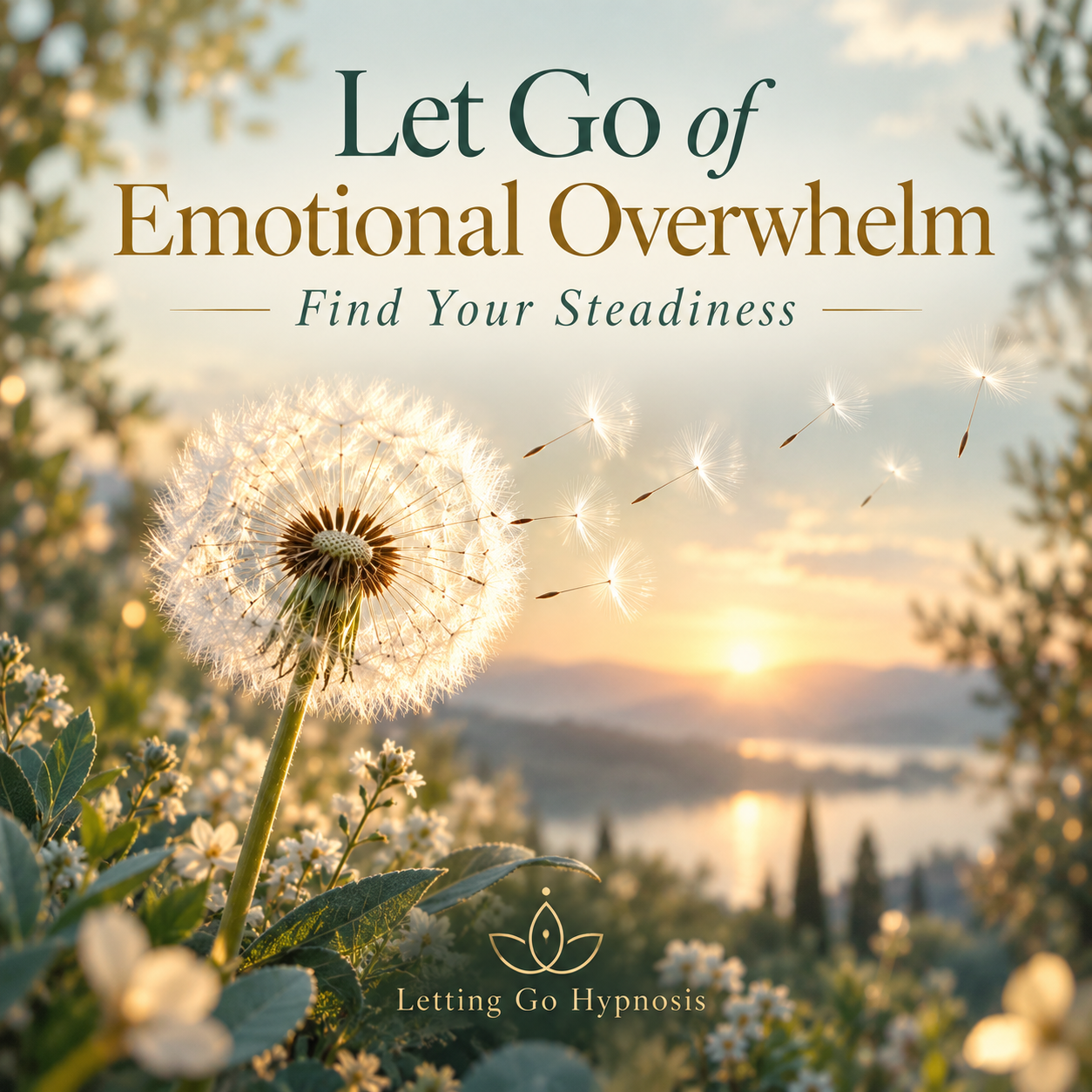
Listen: Let Go of Emotional Overwhelm and Find Your Steadiness
This 34-minute guided session is narrated by Theo Silk, with “Mystic Dawn (Theta)” by Christopher Lloyd Clarke, licensed by Enlightened Audio.
Watch the full session on YouTube. To keep a downloadable copy, get the MP3 in the shop. You can also explore the Letting Go Hypnosis app on Google Play.
Frequently asked questions
What should I do first when I feel emotionally overwhelmed?
Pause somewhere safe, notice your surroundings, and choose one small next step. If breathing exercises do not feel comfortable, use another anchor, such as the feeling of your feet on the floor.
Do I have to get rid of the feeling before I act?
No. You can acknowledge the feeling and still decide what would help now. Sometimes the useful next action is a break, a conversation, or asking for practical support.
When is the best time to listen to this hypnosis recording?
Choose a quiet period when you can sit or lie down safely and do not need to stay alert for driving or other tasks. Allow a little time to reorient afterwards.
How often can I use it?
There is no required schedule. Use the recording when it feels helpful, and stop if you feel uncomfortable. If overwhelm keeps returning or interferes with your life, seek individual support as well.
Where can I get more support?
Speak to a GP or qualified mental health professional if you need help understanding persistent or worsening symptoms. In England, adults can also self-refer to NHS talking therapies for anxiety and depression.
A steadier next moment
You do not have to work through every feeling or finish every task at once. Start with a pause, a little kindness, and one manageable choice. Return to the recording whenever a guided space to slow down feels useful.
Related reading and further support
Explore how to stop overthinking, letting go of perfectionism, and how hypnosis works. For independent guidance, see the NIMH stress fact sheet and the NHS mindfulness guide.
General wellbeing and educational information. It is not a diagnosis, medical or psychological treatment, or individual advice. The cited organisations do not endorse Letting Go Hypnosis or this recording. Experiences vary.