
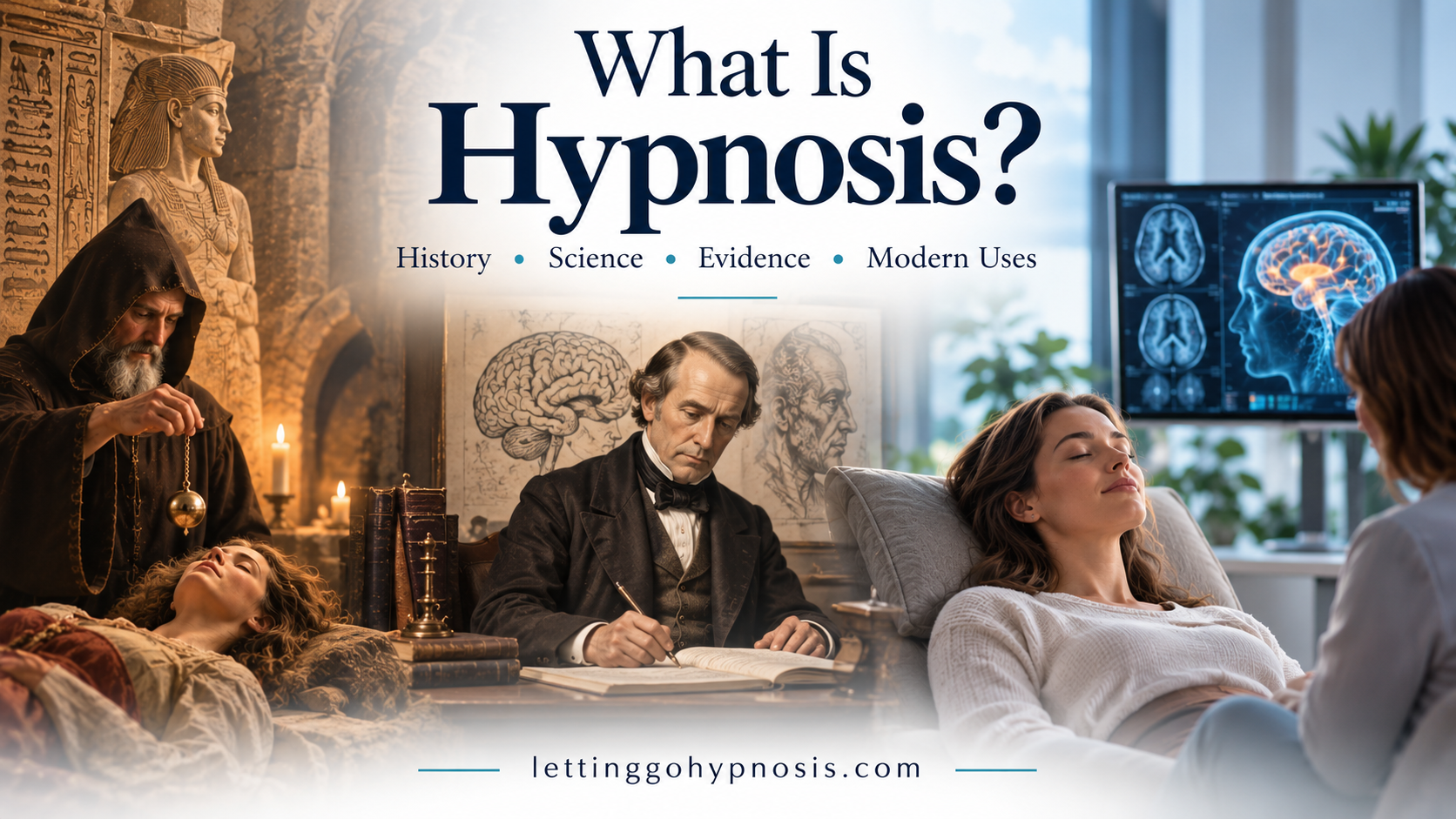
What Is Hypnosis? How It Works, Its History, Evidence and Modern Uses
Hypnosis is a state of focused attention in which a person may become more responsive to suggestion while remaining capable of awareness and choice. Far from the popular image of mind control, modern clinical hypnosis is studied within psychology and medicine. This guide explains what hypnosis is, where it came from, how it may work, what the research actually supports, and how it is used today.
What is hypnosis?
There is no single theory that explains every aspect of hypnosis. In practical terms, hypnosis usually involves deliberately focusing attention, reducing attention to competing stimuli, and using verbal suggestions, imagery or other techniques to influence experience or behaviour.
A hypnotic session may include relaxation, but relaxation is not the same thing as hypnosis and is not always necessary. A person can be deeply absorbed without being asleep. People also vary considerably in how strongly they respond to hypnotic suggestions.
The American Psychological Association describes a substantial scientific literature around clinical hypnosis, including research into pain, anxiety and its use alongside other psychological interventions. Read the APA overview of clinical hypnosis.
Are you asleep or unconscious during hypnosis?
No. The word hypnosis has historical links with sleep, but hypnosis is not simply sleep. Most people can hear the practitioner, notice what is happening and remember the session. Experiences vary: some people feel deeply relaxed, others notice intense concentration, vivid imagery or a sense that suggestions occur with less deliberate effort.
Hypnosis should therefore not be understood as surrendering control to another person. Ethical practice depends on consent and cooperation.
A brief history of hypnosis
Practices involving focused attention, ritual, repetitive speech, prayer, contemplation and altered states of awareness are far older than the scientific study of hypnosis. Similarities can be found across many cultures and historical periods, including medieval religious and healing traditions. It would be misleading, however, to label all of these practices “hypnosis” in the modern clinical sense. Modern hypnosis emerged much later from attempts to explain suggestion and unusual changes in perception and behaviour.
Franz Mesmer and animal magnetism
In the eighteenth century, physician Franz Anton Mesmer promoted a theory he called animal magnetism. Mesmer believed that an invisible force or fluid influenced health and could be manipulated. His proposed mechanism did not survive scientific scrutiny, but the responses seen in mesmerism became historically important. Later investigators increasingly looked to psychological suggestion and expectation rather than a mysterious magnetic fluid.
James Braid and the nineteenth century
Scottish surgeon James Braid is one of the central figures in the development of modern hypnosis. In the 1840s he investigated mesmerism and rejected the idea that a magnetic fluid was necessary. His work helped shift attention toward concentration, suggestion and physiological or psychological processes. The terminology evolved, but hypnotism became closely associated with this new attempt to understand the phenomenon scientifically.
From spectacle to psychology and medicine
During the late nineteenth and twentieth centuries, hypnosis attracted clinicians and researchers as well as stage performers. Competing theories developed around suggestion, dissociation, attention and altered states of consciousness. Today hypnosis is investigated experimentally and is used by some appropriately trained health professionals as an adjunct to established care.
How does hypnosis work?
Scientists do not reduce hypnosis to one simple brain mechanism. Contemporary research examines attention, expectation, imagination, suggestion, learning and changes in the way people experience sensations and actions. Brain-imaging research has also investigated networks involved in attention, salience and cognitive control, but neuroscience does not support the idea of a single “hypnosis switch” in the brain.
One useful way to think about hypnosis is as a structured context in which attention becomes highly focused and suggestions can shape perception or experience. A suggestion might invite someone to reinterpret discomfort, imagine a calm situation vividly, or rehearse responding differently to a familiar trigger.
What does hypnosis feel like?
There is no universal hypnotic feeling. One person may experience heaviness and physical relaxation. Another may feel mentally alert but absorbed. Some experience imagery vividly; others respond primarily to words, sensations or ideas. A dramatic sensation is not required for a session to be useful.
Everyday absorption—becoming engrossed in a book, film or familiar journey—is sometimes used as an analogy. It is not identical to formal hypnosis, but it helps explain how attention can narrow while awareness of other things temporarily becomes less prominent.
Hypnosis and the brain
Modern research has moved hypnosis firmly into the study of cognition and consciousness. Researchers use behavioural experiments, physiological measures and neuroimaging to examine how suggestions can influence pain, perception, movement, memory and attention. The APA notes that decades of research now inform clinical hypnosis while important questions about mechanisms and individual differences remain. Explore the APA review of the science.
What is hypnotherapy?
Hypnosis describes the process or state; hypnotherapy generally describes the therapeutic use of hypnosis. A session might combine an induction, focused attention, imagery, therapeutic suggestions, rehearsal of future situations and a return to ordinary alertness. The exact approach depends on the aim and the practitioner’s training.
Hypnotherapy should not be presented as a universal cure. For health conditions it may be used alongside, rather than as a replacement for, appropriate medical or psychological care.
What is hypnosis used for?
Hypnosis has been studied for a wide range of purposes, but the strength of evidence differs markedly from one use to another. This distinction matters. A responsible discussion should separate established or promising applications from marketing claims that go beyond the evidence.
Pain
Pain is one of the better researched applications. Reviews discussed by the APA report meaningful reductions in experimentally induced pain for many participants, with response influenced by hypnotic suggestibility. Clinical research has also explored acute, procedural and chronic pain. Hypnosis should never be used to delay diagnosis of unexplained pain.
Irritable bowel syndrome (IBS)
Gut-directed hypnotherapy is one of the clearest examples of hypnosis appearing in clinical guidance. In the UK, NICE says psychological interventions including hypnotherapy may be considered for people with refractory IBS who have not responded to pharmacological treatments after 12 months. In the US, NCCIH reports evidence that gut-directed hypnotherapy can improve IBS symptoms and quality of life, while noting limitations in evidence quality. See the NICE recommendations and the US NCCIH hypnosis summary.
Anxiety and medical procedures
Hypnosis has been investigated for anxiety, particularly anxiety associated with medical and dental procedures. NCCIH describes some promising findings but says the overall evidence is not conclusive. That is different from claiming hypnosis is a proven treatment for every anxiety disorder.
For everyday worry and relaxation, see How to Ease Anxiety and Let Go of Worry.
Smoking and behaviour change
Hypnosis is widely promoted for stopping smoking, but research findings are mixed. NCCIH describes smoking-cessation results as conflicting. Anyone trying to stop smoking should consider established cessation support as well as any complementary approach. Read How to Stop Smoking and Let Go of the Habit.
Stress, relaxation and sleep
Hypnotic recordings are often used to create a structured period of relaxation, focused attention and mental rehearsal. Relaxation can be valuable, but claims about treating clinical sleep or stress disorders require appropriate evidence. See How to Let Go of Stress and Deeply Relax and How to Let Go of the Day and Sleep Naturally.
Confidence, performance and habits
Hypnosis is also used in personal-development contexts to rehearse desired responses, focus attention and encourage behaviour change. The evidence for a specific outcome depends on what is being targeted, and personal-development recordings should not be confused with treatment for a diagnosed medical or mental-health condition.
Related guides include self-confidence, social confidence, confidence at work, procrastination, study focus, exercise motivation, imposter syndrome and perfectionism.
Can hypnosis make you do something against your will?
The theatrical image of a hypnotist taking complete control is misleading. Hypnosis relies on participation and suggestion. People do not become mindless or lose their identity simply because they are hypnotised. Stage hypnosis also involves selection, expectation, social context and willing participation, making it a poor model for understanding a private therapeutic session.
Can everyone be hypnotised?
People differ in hypnotic responsiveness. Some respond strongly to a wide range of suggestions, many respond moderately, and others respond less. Motivation, expectations, context and the particular suggestion can also influence an individual’s experience. Hypnosis is therefore not an all-or-nothing ability.
Hypnosis, meditation and mindfulness: are they the same?
They can overlap in focused attention and changes in awareness, but they are not interchangeable. Mindfulness often emphasises observing present experience without trying to change it. Hypnosis commonly uses suggestions designed to alter an experience, response or behaviour. Meditation encompasses many traditions and practices, some with goals very different from hypnotherapy.
What is self-hypnosis?
Self-hypnosis is the deliberate use of hypnotic techniques without a practitioner delivering the session live. A person might use breathing, focused attention, imagery and planned suggestions, or listen to a recorded session. Repetition can make the process familiar and may help a listener practise a desired response consistently.
Is hypnosis safe?
Hypnosis has a generally good safety record when used appropriately, but “natural” does not mean suitable for every person or situation. NCCIH notes that hypnosis could worsen symptoms in some people with certain mental-health conditions. It should not replace assessment or treatment for serious symptoms, and recordings designed for deep relaxation should never be used while driving, operating machinery or doing anything requiring full attention.
If you have a medical or mental-health condition, severe or worsening symptoms, unexplained pain, suicidal thoughts, psychosis, or uncertainty about whether hypnosis is appropriate for you, seek advice from an appropriately qualified healthcare professional. In an emergency, use your local emergency service.
What does the scientific evidence actually say?
The most accurate answer is: it depends on the outcome. Hypnosis is not supported equally for every claim made about it.
The US National Center for Complementary and Integrative Health reports evidence for gut-directed hypnotherapy in IBS and a growing evidence base for some forms of pain management. It describes results for procedure-related anxiety as promising but not conclusive, and smoking-cessation findings as conflicting. NICE includes hypnotherapy among psychological interventions that can be considered for refractory IBS. The APA’s reviews describe substantial research into pain and the use of hypnosis alongside established psychological interventions.
This is why responsible hypnotherapy should avoid promises of guaranteed outcomes. Evidence should be considered condition by condition, and hypnosis may sometimes be best understood as an adjunct to other care rather than a replacement for it.
Common hypnosis myths
- Myth: hypnosis is sleep. Hypnotised people are generally capable of awareness and response.
- Myth: the hypnotist controls your mind. Hypnosis depends on cooperation and suggestion.
- Myth: only weak-minded people can be hypnotised. Responsiveness is not a measure of weakness or intelligence.
- Myth: hypnosis is magic. Modern hypnosis is investigated through psychology, neuroscience and clinical research.
- Myth: hypnosis works for everyone in the same way. Responses and outcomes vary.
Explore Letting Go Hypnosis
This guide is part of Letting Go Hypnosis, where you can move from learning about hypnosis to experiencing professionally created recordings for yourself.
- Explore the website: visit Letting Go Hypnosis for free resources, practical guides and the latest recordings.
- Browse the recording shop: explore the full hypnosis catalogue. Recordings are purchased individually with permanent access and no subscription.
- Watch free hypnosis videos: visit Letting Go Hypnosis on YouTube to discover full sessions and other free video content.
- Take your library with you: download Letting Go Hypnosis for Android on Google Play to keep recordings together, stream them and download purchased sessions for offline listening.
- iPhone and iPad: the Letting Go Hypnosis iOS app is planned, so Apple users can continue to use the website while it is being prepared.
New to Letting Go Hypnosis? Start with the free Deep Sleep Reset recording, then explore the catalogue when you are ready.
How hypnosis is used at Letting Go Hypnosis
Letting Go Hypnosis recordings are designed as structured personal-development and relaxation experiences. Sessions move through settling and focused attention into deeper absorption, change-focused suggestions or mental rehearsal, integration and a gradual return to ordinary alertness. Sleep recordings may instead end by allowing natural sleep to continue.
The catalogue covers areas including overthinking, relaxation, confidence, habits, fears, study and personal growth. You can also explore How to Stop Overthinking and Quiet Your Mind, How to Feel Calmer About Flying, healthy eating habits and coping with a breakup.
Frequently asked questions about hypnosis
Is hypnosis real?
Yes. Hypnotic phenomena are studied experimentally, and clinical hypnosis has a scientific research literature. That does not mean every claim made in the name of hypnosis is supported by evidence.
Will I lose control?
Hypnosis does not turn someone into a mindless subject. Participation, context, expectation and suggestion all matter.
Will I remember what happened?
Most people remember a session. Memory can be influenced by suggestion, however, which is one reason hypnosis should not be treated as a reliable method for recovering supposedly hidden memories.
How quickly does hypnosis work?
There is no universal number of sessions. Outcomes depend on the person, aim, intervention and context. Claims of guaranteed results after one session should be treated cautiously.
Can I use hypnosis at home?
Many people use self-hypnosis or recorded sessions at home. Choose an appropriate setting where you can safely relax without needing to drive or remain alert.
The modern view of hypnosis
Hypnosis has travelled a remarkable path: from historical practices that attempted to explain unusual states of attention, through mesmerism and nineteenth-century experimentation, to modern psychological and clinical research. The supernatural explanations largely fell away. What remained was a fascinating and measurable interaction between attention, expectation, suggestion, imagination and experience.
Modern evidence does not justify calling hypnosis a cure-all. Nor does it justify dismissing it as mere stage entertainment. The more useful position lies between those extremes: hypnosis is a genuine psychological phenomenon with evidence supporting some applications more strongly than others, and research continues to refine our understanding of when, why and for whom it may be useful.
Important: Letting Go Hypnosis content is for relaxation, education and personal development and is not a substitute for diagnosis, medical care or mental-health treatment. Never listen while driving or operating machinery.

2 Comments