
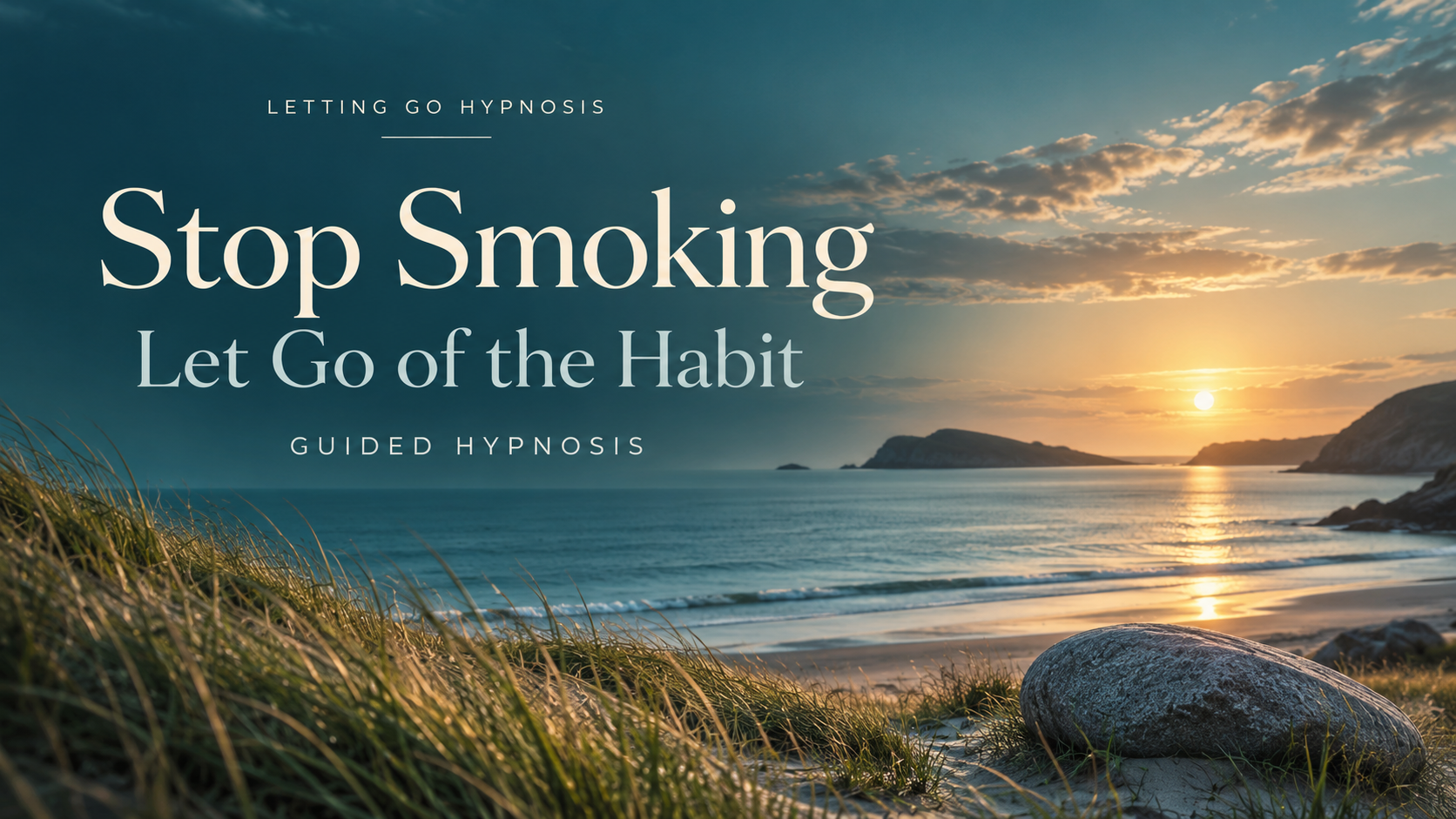
How to Stop Smoking and Let Go of the Habit
You finish a meal and reach the familiar pause afterwards. Before you have decided what to do next, the thought appears: time for a cigarette.
You may want to stop smoking and still feel that pull. The intention to change can be clear while the next few minutes feel less straightforward.
Stop Smoking — Let Go of the Habit is a guided hypnosis recording built around that moment. It offers space to settle, explore a manageable urge and imagine continuing the day without following the smoking routine.
The recording is designed to complement a quit plan and appropriate stop-smoking support. It does not replace treatment for nicotine dependence or promise that cravings will disappear.
Listen free on YouTube · Buy Stop Smoking — Let Go of the Habit
Why familiar moments can bring the urge to smoke
Smoking can become linked with particular parts of the day: finishing food, drinking coffee, taking a break or spending time with people who smoke. Feelings such as stress and restlessness can also become triggers.
Nicotine withdrawal can contribute to cravings too. A strong urge is therefore more than a question of how much you want to change. The NHS explains this combination of routines, situations and withdrawal in its guide to smoking triggers and cravings.
For this recording, the focus is one familiar sequence: a meal ends, an expectation appears, and there is an opportunity to choose what happens next.
That sequence gives the session a clear, practical setting. You have a particular moment to work with, rather than an entire future to imagine at once.
The Letting Go process: making room for an urge
In the recording, you are invited to recognise a mild version of the wanting without immediately moving into the smoking routine.
There may be restlessness in the fingers, tension around the mouth or an impatient thought. Alongside it, there may be a second pressure: the demand that the feeling must go away immediately.
The Letting Go process explores whether some of that struggle can soften.
Could the jaw ease? Could the fingers uncurl? Could the sensation have a little room while you remain aware of the support beneath you?
This is an invitation to explore your response, not a requirement to make a craving vanish. The session leaves room for the feeling to remain while you imagine taking a different action.
Its central theme is simple: there can be space between the urge and the choice that follows.
What you will experience in the recording
This 34-minute 36-second session begins with safety guidance, physical settling and an unhurried coastal deepening. You follow the sound of water along the shore, the movement of dune grass and the texture of a gently warmed stone.
From there, the recording explores:
- Remembering a personal reason for stopping smoking.
- Recognising the familiar expectation after a meal.
- Easing the effort around a manageable urge.
- Imagining a drink of water, clearing a plate and enjoying music as the evening continues.
- Declining an offered cigarette with a brief, comfortable response.
- Keeping support available and choosing a practical next step.
The main rehearsal stays with the after-meal experience long enough to reach its quieter ending. A shorter social scene follows, where you decline a cigarette and remain involved in the conversation.
You can follow through images, sensations or the meaning of the words. The session finishes with a gradual return to alertness.
Staying through the after-meal pause
One detail in the recording deserves attention: what happens after the first different choice.
You imagine lifting a glass, taking a sip and putting it down. Some wanting may still be present. The evening continues anyway.
You carry the plate through, hear water meeting its surface and set it in the rack. Later, you settle with a piece of music and stay through the final note.
The rehearsal gives attention to continuing, as well as beginning. It includes the possibility that the thought of smoking returns while there is still something else to do or enjoy.
The glass of water is one concrete action within that scene. It is not presented as a treatment for withdrawal. Your wider quit plan remains part of the picture.
A small way to practise between listening sessions
Choose a manageable moment when you are safely able to pause. Use this brief practice alongside your quit plan.
1. Recognise the familiar pull
Try a simple acknowledgement: “There is the urge.” You are identifying what is happening without turning it into a judgement about yourself.
2. Ease some of the effort around it
Check whether your jaw or fingers are bracing. If it feels comfortable, soften that effort slightly. You are exploring a gentler response, without needing to prove that the feeling has changed.
3. Feel your feet and follow one natural breath
Keep the breath comfortable. There is no need to force its depth, hold it or achieve a particular rhythm.
4. Choose one action from your plan
Take the next practical step you have prepared. That might include a different after-meal activity, contacting support or using your stop-smoking treatment as directed.
5. Give your attention to what comes next
Stay with the activity you chose for a while. If the urge is difficult to manage, use the additional support in your plan. You do not have to wait until you feel overwhelmed to reach for help.
The NHS recommends preparing for your quit with a plan and appropriate support. This short exercise is one practice you can place within that wider preparation.
Can hypnosis help you stop smoking?
This recording provides a structured opportunity to relax and rehearse responses to familiar smoking situations. That describes its purpose; it does not establish how effective it will be for an individual listener.
A 2019 Cochrane review of hypnotherapy for smoking cessation found insufficient reliable evidence to show that it was more effective than other behavioural support or quitting without assistance. The evidence was of low or very low certainty.
We therefore present this session as an optional supporting practice. It should sit alongside appropriate stop-smoking help, with no guarantee of a particular outcome.
If you are new to guided sessions, How Hypnosis Works explains the format of our recordings.
Keep practical support close
You can seek help before your quit date, during the early stages or after a difficult day. A pharmacist, clinician or stop-smoking adviser can discuss the options appropriate for you.
In the UK, NHS stop-smoking services provide advice and support, including help with suitable treatments. In the United States, Smokefree.gov offers quit-planning tools and support resources.
If you smoke after stopping, respond promptly and review what would help next. The NHS recommends learning from the situation, strengthening your plan and seeking help where needed in its guide to getting back on track after smoking again.
The recording takes the same compassionate position: what happened deserves attention, and your next step still matters.
How to listen safely
Choose a time when you can rest without needing to respond immediately. Sit or recline comfortably and use a comfortable volume. Headphones are optional.
Put out any cigarette before beginning. Never listen while driving, operating machinery or doing anything that requires your attention.
You can move, open your eyes or stop at any point. If an imagined situation feels too intense, leave it and reconnect with your actual surroundings. Give yourself time to become fully alert before standing or returning to activities.
Listen to Stop Smoking — Let Go of the Habit
The recording brings together sensory relaxation, the Letting Go process and a sustained rehearsal of a smoke-free evening.
Choose how you would like to listen
Listen to the complete recording free on YouTube
Experience the full guided session before deciding whether you would like to own a copy.
Buy the permanent, ad-free MP3
Purchase your own copy through the Letting Go Hypnosis shop, with permanent access and no subscription.
You can also explore the Letting Go Hypnosis Android app or browse the wider recording collection.
Related listening and reading
For the pressure you carry into the evening, explore How to Let Go of Stress and Deeply Relax After a Busy Day.
If your attention becomes caught in repeated internal arguments, How to Stop Overthinking and Quiet Your Mind explores another aspect of letting go.
These are complementary wellbeing topics, rather than substitutes for smoking-cessation support.
Give your next choice some room
The next familiar pause may arrive after a meal, during a break or in conversation.
Your reason for stopping can remain close. So can your plan, the support you have arranged and one clear action to begin.
Feel your feet. Follow a natural breath. Give your attention to the next step you have chosen.
Then make room for the part of your day that comes after it.
Begin listening to Stop Smoking — Let Go of the Habit · Get your own copy
Letting Go Hypnosis — Professional hypnosis recordings for real-life change.
Created by Letting Go Labs Ltd.
Narration: Theo Silk, created using ElevenLabs AI voice technology for Letting Go Hypnosis.
Background music: Mystic Dawn (Theta), composed by Christopher Lloyd Clarke and used under licence from Enlightened Audio.
Safety and scope: This article is educational. The accompanying recording is a supporting relaxation and personal-development practice, not a replacement for healthcare or treatment for nicotine dependence. Continue any treatment as directed. Individual experiences and results vary.

2 Comments